Sunday, November 9, 2014

GATEWAY TO THE GREAT BARRIER REEF

                           Cairns, Australia
             Cairns is pronounced cans as the ‘r’ is silent. Although Brisbane is the capitol of Queensland, Cairns is affectionately referred to as the tropical capitol. It is the gateway to the Great Barrier Reef.
My impression was that of a sleepy tropical town, even though the population was 73,000.
            Settled in 1876, it became a town in 1885, and a city in 1932 with a population of approximately 10,000.  We were told that the older homes were built on stilts in order to catch the sea breezes. It is too hot here for many crops to grow, but sugarcane, macadamia, and pineapple do well and there are many such plantations around. Rain evaporates rapidly producing high humidity.
            I’ve snorkeled the Great Barrier Reef twice. The second experience was the better of the two. The Coral Sea borders Australia on the north.  It was a short drive from our hotel to the waterfront where we boarded a catamaran for a trip out to Green Island, 12-15 miles off the coast.
Catamarans are the most common means of transport, probably because of their shallow draft, and because they lend itself to the spaciousness of the accommodations. The catamaran guide informed us that Captain Cook named Green Island which is a natural mature coral cay.
The island is small and houses a restaurant, gift shop, dive shop, toilets, design lockers, and a swimming pool. The tropical foliage lends a very relaxing and calm atmosphere, and there are sandy beaches for swimming. This was my first trip. Green Island is very commercial and the best I can say is that one experiences the reef.
My travel buddy  and I walked the two mile perimeter of the island walking in shallow water.
After lunch  only five of us took a motor boat to the reef to snorkel. Once again  my prescription mask again came in handy.
         The 1258-mile-long Great Barrier Reef  lies 12-32 miles off shore. It protects hundreds of small off shore islands on Australia’s east coast from Brisbane north to Cairns, and the reef itself is protected. The reef contains 400 species of coral. Because I didn’t have a buddy I didn’t wander too far away from the boat, but I was the last one out of the water. The water was shallow in many spots, and there was some current so I was glad I had my fins. I saw several corals I’ve never seen before. The water was warm and the fish were fairly plentiful. It was good snorkeling, but not as good as that I had done in Belize
Snorkeling was a new experience for many people on both trips. On my second trip it was September vs November and we were told that box jellyfish wash down from the rivers and are near the shoreline. This deadliest of all jellyfish has only a fist size body but 4 meter long tentacles. Some beaches enclose a netted area for safe swimming.
             We waded out to a small motor boat that took us out to the waiting Rum Runner IV, a 55-foot catamaran. Thirty young adults joined us on the cat, so the boat was pretty full. It was an hour and a half ride out to the largest coral reef system in the world. 
Most of us were out on deck, and before long the wave splash got us pretty wet, and long before arriving at the reef we were soaking wet. Fortunately although it was a misty day, it was  a warm one. By the time we anchored and got in the water it was actually raining. The water was warm. The snorkeling was quite good.
I kind of swam around by myself, as most had not snorkeled before. The crew was most helpful. After getting everyone fitted with mask, snorkel, (I had my own) and some basic instructions, they took 2-3 at a time holding on to a life ring and towed them around over the reef. For the most part the beginners were thrilled to have had this experience. For me it was a good swim! 
Green Island is by far the most popular spot for tourist to visit the reef. It was way too commercial for me. There was no one around for my second trip to the reef and it was much more pleasant and ‘real’.


Wednesday, November 5, 2014

INTERESTING FOOD AND DRINK

                     Rivella, Fondue, Reclette, Flemish Stew,
            On a recent trip to Switzerland I was introduced to Rivella a Swiss soft drink. Yellow in color, it is clear with a small fizz. It tastes similar to ginger ale but still a bit different. It is made from 35% milk serum, sucrose, caramel and is carbonated. It is an interesting drink. Our Swiss guide told us her dad made her drink it because it was made from milk. After telling friends at home about it and much discussion we decided that since the drink is clear and in no way resembles milk that the ‘milk serum’ is the whey. It was refreshing, but I found it nowhere else nor on any previous trips.

            In Switzerland we found small chunks of coiled potato in the macaroni and cheese. It was good but just a surprise. It seemed the mac and cheese was always served with applesauce.

            Ah the wonderful fondue in Switzerland! At a fondue making party it was a surprise to learn that grated ‘fondue’ cheese was melted in a pot of white wine that finely chopped shallots had been simmering in. I can’t tell you what kind of cheese ‘fondue’ cheese is because I don’t have a clue. I was just following directions to keep stirring. Fondue forks are long handled with two small long tines to grasp the bite-size bread chunks for dipping in the fondue.  Some say if you lose the bread in the fondue you have to kiss the cook.

            Another new Swiss dish on this recent trip was Reclette. In Geneva friends from Wisconsin wanted to introduce us to this new dish, which they make occasionally at home.  Reclette is a special cheese called reclette that is melted and then scraped into a dish and served with cooked but firm small potatoes, gherkins and pickled onions. In Geneva we found a restaurant that served it so we had a chance to try it. It was interesting, but I favor the fondue! 

            One of the best parts of winter for me is meal of nice thick homemade stew or soup. Having Flemish stew in Belgium was a surprise. Our first waiter informed us the stew was good because it was made the real Flemish way. He was right, it was extremely good, but it sure was a surprise when it arrived. I have a hard time with the terminology as stew to me includes lots of veggies and usually potato chunks. Flemish stew is just like the fricassee beef my mother used to make. It is fork tender chunks of beef in gravy. Flemish stew is simmered in liquor---I don’t know if there is a specific kind of liquor, I’m guessing a good whiskey. There was nothing in the stew but the meat. It was served with fries---like everything in Belgium is---and applesauce. I fricasseed meat often when my children were at home, but I never called it stew. It was just the meat dish. After the shock wore off in Belgium I enjoyed the ‘stew’ several times. However, the first in Bruges, just off the main square, was without a doubt the best.

Sunday, November 2, 2014

HOORN, HOLLAND

                            An Historic Town

Hoorn, established in 716, on the Ijsselmeer, offers a combination of old and new. Monumental facades tell of the history of this former headquarters of the Dutch East India Company town dating back to 1357. During Holland’s Golden Age, Hoorn was an important trading center for the company especially in the exotic spices of pepper, nutmeg, cloves and mace.
The street plan has basically remained intact and historic buildings have been retained. The town has at least 300 monuments. Once one of Holland's richest port cities, the town has a rich past. Hoorn is the beating heart of West Friesland and the hub of West Frisian business life.
On a walking tour our guide pointed out a building that originally was a shipyard, then a prison and now it has 28 apartments and a new museum. Of the East India Company’s 325 ships, 40 of them were built here. The tower dates to 1532 with the top being added later.
Many pavement cafes, restaurants and benches for people watching surround the harbor. Hoorn is also a museum town with six museums within walking distance of each other. The West Frisian Museum is the oldest, and the building itself is an exceptional example of Renaissance art. 
The inland area consists mainly of polders. A polder is reclaimed land from marshy areas or the sea via dikes. What used to be water is now land encircled by dikes–the Omringdijk (encircling dike) is the oldest. Man and animal live closely with one another in what is usually a combination of past and present day agriculture with green pastures for cows and sheep, alternating with traditional Dutch farmhouses and villages. A variegation of color begins in the spring with flowering bulb fields.
Hoorn's 70,000 inhabitants, representing about 80 different nationalities, live in the old city center and the districts built around it. Young and old coexist happily and that extends to both people and buildings. Modern architecture is carefully blended into the historic townscape.
All of the little towns/ villages we had the pleasure of visiting were a real treat. It is so nice to see preservation working, and it is alive and well in the Netherlands.

Wednesday, October 29, 2014

RUSSIAN ODDS AND ENDS

                      Russian Sayings and Beliefs

           Most Russian homes, especially in the countryside have a ‘red corner’. Originally that is where the religious icons were displayed. After the Bolshevik Revolution the religious icons were replaced with busts of Lenin and Stalin. Since the demise of the USSR in 1989 the religious icons again have a place of honor.
            Russians believe they have an angel on or over the right shoulder and the devil on or over the left shoulder. By spitting three times over the left shoulder sends the devil away.
           
            Flowers are always given in odd numbers.
           
            Never shake hands with a Russian over a threshold.  Step inside the room, otherwise it is bad luck.
            Always use the middle finger to point at something, never use the index finger as Americans do.
            When taking a picture Russians say, say raisins, which in Russian sounds better than say cheese, which just brings a confused look to a Russian.

            Denge means money, chi means tea, zavaka means tea concentrate, pravda means truth.

Russian nesting dolls are called matryoshka.

The brightly colored and decorated lacquered boxes are called palekh. 

Russian expressions:
            Russians say got up on the left leg, not the wrong side of the bed.

            The expression when elephants fly becomes when crawfish whistle in Russian.
           
            The quieter you go the farther you get is equal to our haste makes waste.
           
            Two peas in a pod becomes two drops of water to a Russian.
           
            The first pancake has lumps is equivalent to if you don’t at first succeed, try try again.
             

Sunday, October 26, 2014

ICE CAVES

                             Ice Adventures
         It seems today that ice bars and other oddities are not really common but not unusual either. According to the internet there are many in large cities around the world. They are not high on my priority list but I do remember seeing an ice bar in Reykjavik, Iceland. I did not visit it but I did note that each visitor was given a heavy jacket before entering.
       Now ice caves are another story and I’ve visited two:

Titlis -Switzerland
      The ice cave in this glacier was constructed in 1974-78. It is 427’ long and has a constant temperature of 30-31 degrees. There are several rooms in the cave. Being my first I found it both intriguing and rather unusual. The ice in this glacier ranges from 15-50 meters (48-162-feet) deep. We were told it takes ten years for one meter of snow to become ice. Since this visit took place ten years ago I wonder how global warming has affected both the glacier and the ice cave—probably not much effect on the ice cave yet.
      Once we had wandered through the cave not once but twice,  we headed to the large cafeteria on the same level for something hot to drink.

Mer de Glace  -France  

      The Montenvers rack railway starts in Chamonix and 20-minutes later lets one out up on the mountain. Then it is down, down to reach the entrance of the Mer de Glace situated at 1,913meters or—6217-feet in France’s largest glacier measuring 7km  or 4 1/3 mi long, and  200 m or 656-feet thick. Entering the Grotte de glace (Ice Cave) actually takes you into the very heart of the glacier.
      Resculpted every year, posters inside describe the life of mountain people in the early 19th century. A crew outside the cave shoveled slush into a dump-truck like vehicle to be carried away. A gondola is available to take you down maybe 100 feet---I’m not a big judge of distance but it was a very short distance

and ride.  Then one starts down 400 steps to the cave entrance. That was the easy part! After your fill of cool air and ice, it is a 400 step trudge back to the top! The steps zig zag down the mountain and are broken every 15-20 steps with a short level platform. By stopping on each platform on the way up to not only return my breathing to normal but to savor the scenery and the moment I managed to save my knees from hurting and was in fine shape when back on top.
      The cave also can be reached by a 20 minute-walk on a footpath. Somehow we missed, although were not looking for, the path. I doubt it would have been any easier.
       There are two choices for eating: either coffee or ice cream at the railway station café or full meal at the restaurant in the Grand Hotel in Montenvers. The hotel, built in 1880, has history and authenticity.  In the summer, the hotel serves its original purpose, i.e., accommodating mountaineers, travelers and adventurers, just as it did in the late 19th century. Its nine rooms and dormitory have retained the charm and simplicity of bygone days.
      We by-passed both eateries, as I wanted my daughter to have the experience of lunch in a real French sidewalk café. It was a good choice as we leisurely enjoyed our meal.


Wednesday, October 22, 2014

MONET AND GIVERNY

                         Monet's Home and Garden
                          
      I was excited to learn we were going to make an unscheduled stop—to Monet’s home and gardens! The highlight of this trip was Normandy so it was a real bonus.
      Claude Monet noticed the village of Giverny while looking out of a train window. He made up his mind to move there and rented a house and the area surrounding it. In 1890 he had enough money to buy the house and land outright and set out to create the magnificent gardens he wanted to paint. Monet lived in Giverny from 1883 until his death in 1926. He and many members of his family are interred in the village cemetery.  
      Following restoration, Monet's house and gardens were opened to the public in 1980.We wandered around the lily ponds first and over the stream bridges. The beautiful gardens were so quiet and peaceful. Still
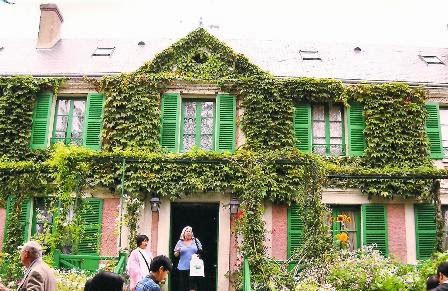
Monet's home
in bloom the gardens were a profusion of color. Sunflowers were 7-8 feet tall with blossoms the size of dinner plates. I was able to identify many of the flowers but there were also many that I could not. I look a lot of pictures and my very favorite, which is now my screen saver, is a gorgeous pink and white peony, the bloom of which rivaled the size of the sunflowers!
      Monet initially painted the countryside, but after buying the house, he began transforming the gardens. He used different heights to create volume. Fruit trees or ornamental trees dominate the climbing roses, the long-stemmed hollyhocks and the colored banks of annuals. Monet mixed the simplest flowers, daisies and poppies, with the rare varieties.
Part of his water garden
      The Japanese inspired water garden and the surrounding vegetation form an enclosure separated from the surrounding countryside He had a water-garden constructed, even diverting the local river to achieve his vision.. The famous Japanese bridge was built by a local artisan. The pond was inspiration for his famous water lily paintings. He also painted a lot of weeping willows as a memorial to those lost in WW I. 
      We spent a lot of time on the gardens, and eventually moved into the house. The original house was much smaller than it is today. Monet enlarged it on both sides. Monet loved color and chose all the colors in the home. The house is pink with green shutters—a marked deviation of the normal grey shutters of Victorian times. The barn next to the house became his first studio, thanks to the addition of a wooden floor and of stairs leading to the main house. Monet, who mostly painted in the open air, needed a place to finish and his store canvases.
      Monet added a gallery in front of the house; a pergola covered with climbing roses, and grew a Virginia creeper on the façade---he wanted the house to blend with the garden. 
      Blue is used extensively throughout the home. The dining room though is painted a vibrant yellow with blue tiles to coordinate with the blue kitchen when the door was open. Walls showcased Japanese engravings that Monet chose with an expert eye. For fifty years, he collected the prints by the best Japanese artists.
      Monet was one of few who became famous during his lifetime, although he had to wait until he was fifty before he was recognized as a master.
      It was a thrilling visit that definitely put Giverny  on my revisit list!