Showing posts with label Outback. Show all posts

Wednesday, November 14, 2018

Australia's Flying Doctors


                                              Busy Medical Service
     Wireless, wings, and stethoscopes---Down Under that refers to the Royal Flying Doctor Service. I looked forward to and was fascinated with the interesting visit to the service  in the middle of the Australian Outback.
    In a small auditorium we viewed a fantastic film of the Service in action, learning that the service started in1928 with one plane. Today, in Alice Springs, the Service operates with six doctors, six nurses, six pilots, three planes and three engineers.  The goal is to do three clinics a day or 1000 a year in the Outback.
    Everyone works a 12-hour shift for two days, has one day off and then repeats. The  annual budget is 9-million dollars. Tourists involved in accidents, many at Uluru or Ayers Rock, account for 18% of their calls, and most of the averaged five evacuations a day are also from Uluru.
     A drug box containing 100 drugs packaged by number, not name, is kept at numerous outposts around the country. Much prescribing is  done by phone. The Service at Alice Springs covers an area of 70 kilometers in any direction from the city. The population of this area, including the city, is approximately 16,000. The pilots have access to 150 air-strips. The entire Service covers 2.3 million square kilometers.
    Today the Service is in the hands of six mainland sections, each having one or more radio control stations. There are 16 base locations around the country from which Flying Doctors operate. In total the Service employs 27 doctors, 58 nurses, 65 pilots, 34 engineers, 51 admin staff,46 mechanics and other staff and 9 general hands.
    No other service in the world operates over such a vast territory providing such a comprehensive health service. They are not merely an aerial ambulance, but a remote area health care provider. They are 2 hours or less from each location. What a fantastic service and outfit!

Sunday, September 23, 2018

ULURU


                                                 One Big Rock 
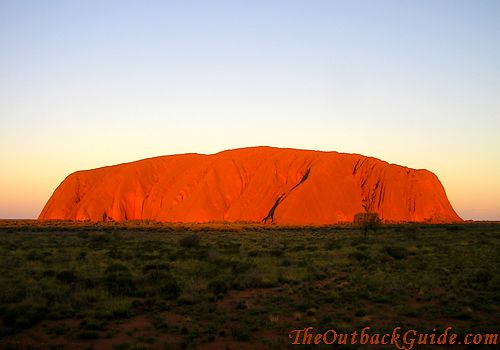
      Uluru is an Aboriginal word referring to a water hole near the summit of the 1150-foot high sandstone monolith, commonly known as Ayers Rock. It is one of the world’s greatest wonders. Like an iceberg, two-thirds of the huge rock lies under the ground. There are many caves in the rock and 75 art sites. The Red Center of the Outback is geographically in the center of Australia.
     The Outback is pretty barren and there is little civilization, just farms with huge amounts of acreage. During the long ride we saw many road-trains on the well paved flat road. A road train is an 18 wheeler with 5-6 trailers attached. They seem to go on forever and are tricky to pass; however they clip along at a good speed and there is little need to pass them.
Ayers Rock picture     The Northern Territory government built  the only hotel complex in the area. It accommodates four hotels ranging from five-star to a backpack hostel, post office, restaurants, and a store.
     In the early evening, the ride to Uluru from the hotel was a short one. While I gazed at the rock in amazement, the driver and guide set up a small table with snack foods and champagne. Sipping champagne is traditional  while watching the sun set on the rock. Sunsets are fantastic with the colors changing about every two minutes. I’ve seen a lot of beautiful sunsets but this one did not disappoint as the colors were magnificent; however the changing colors were difficult to photograph without a really high-tech camera, so I just watched trying to commit the experience to memory.
     The next morning I got up early to walk the five and a half miles around the rock before it got hot under a blazing  sun. Because Uluru is sacred to the Aborigines, the once popular activity of climbing the rock to the top is discouraged. Half of the emergency calls to the Flying Doctors involved accidents while trying to climb the monolith, broken bones a common mishap.
     We all decided to honor the culture and walk around the rock rather to climb it. Because of recent rains, including the night before, the path around the rock was wet in places and at times it was necessary to maneuver around puddles and spongy soil.
     In spite of that plus stopping to read interesting signs along the way, we finished the walk in two hours. Starting at daybreak we watched the sun rise over the rock. It was a memorable hike and by the time we finished the temperature was beginning to climb. It was going to be another hot day! It was time for breakfast.

Wednesday, March 9, 2016

A COUPLE AUSSIE SURPRISES


                        Always Learning Something New
The Remote
      When traveling, my buddy and I agree that there is too much to see and do in a new place to turn on the TV. We figure if anything wild is going on in the world someone will let us know about it.
      We were in Melbourne, Australia in late 2000 when we the president had not been decided yet. Everywhere we went people asked, “What’s the matter with you Americans? Why can’t you elect a president?”
      One day, after tramping all around the city, we returned to our delightful little boutique hotel. Upon entering our room I asked, “Do you think we should turn on the TV and see if we have a president.”
     “I’m really getting tired of all the questions. I think maybe this might be an exception. The remote is there. Go ahead and turn the box on,” she replied.
      Picking up the remote I pushed the power button. Nothing happened, so I pushed it again. And again. Again. Exasperated I threw the remote on the bed disgustedly saying, “I know I’m technologically challenged, but you’d think I could turn on a darn TV!”
     Just about that time she grabbed her blouse and said, “It’s sure hot in here.”
     Simultaneously, we both looked at her bedside table and saw another remote. She picked it up, pushed the power button and, waala, we had TV! We started to laugh as we realized I had the heat remote and I’d been turning up the heat with every push of the button!
      For years after that, every time we walked into a new hotel room, we’d look at the TV and one of us would say, “Remember Melbourne?” and have a good chuckle.


Early Wakeup Call
      In the Australian Outback the wake-up call came at 3:15 AM. It was only a short ride to the field where our balloon waited, deflated on the ground. We all pitched in to arrange the balloon so it could receive air and inflate. At daybreak we quietly floated over browsing cattle and wild horses running on the plain below. Mobs of kangaroos were hopping everywhere. The animals were way too numerous to count. The unbelievable quiet tempered our comments even though we were all excited.
       I tried to capture the spectacular sunrise on film but wasn’t very successful. As the day lightened we spotted several other balloons in the air. This was my third balloon ride and I’m always amazed at the incredible peaceful quietness.
       All too soon, it was time to descend. After a safe landing everyone pitched in to fold up the balloon and pack it away in its compact holding case.
       On the way back to town we stopped at a tavern that opened just for us early in the morning, We all enjoyed the traditional champagne breakfast and the silence was no more. No restraint on our excitement and noisy comments. Eating on the patio that lovely warm morning enjoying good food, sipping champagne and enjoying good camaraderie was a wonderful fun way to start a day!

Sunday, April 26, 2015

ALICE SPRINGS, AUSTRALIA

                                    The Isolated Outback

      Alice Springs in the far-off outback is a small community but held several wonderful interesting visits. We rode the overnight Ghan Train for the long trip. Afghani camel-trains, carrying supplies, made the long 970-mile trek between Adelaide and Alice Springs for many years, thus the name Ghan Train.
     A paved road between the two cities did not exist until 1980. The train traveled over level ground in the center of the country. After the wheat fields of the Flinders Range, it was flat expanses of salt bush. Flat, flat, flat!  
    After the really nice hotels we’d been accustomed to, the very basic hotel here was a bit of a surprise, but was about the best the city offered. It was clean and adequate. We then wandered around the city---all five blocks of it--before visiting the small mall. Not being very big, it held our interest for only a short while. We studied some aboriginal art which is an interesting art form before lunch.
     When I asked for a cup of tea and a glass of ice the waitress said, “We have iced tea.” That made this Texan’s day!
    The city was originally named Stuart after an explorer but renamed Alice Springs after Alice Todd, the wife of the telegraph station building project foreman. In 1939 the population was 700, today the population is 26,000, and the city is the center for Aboriginal artworks, and the base camp for Outback travelers.
     Alice Springs started as a cattle town, and as late as the 1970s the city still had a wild west image. It now survives on the tourist trade. In the Northern Territory, twice the size of Texas, the 178,000 people are outnumbered by sheep and rivaled by kangaroos, dingoes and Afghan camels. There are 1600 Americans living in Alice Springs, most are involved in the NASA tracking station at Pine Gap.  Aborigines account for 20% of the city’s population.
     At the 1792 overland telegraph station a guide took us around the grounds and buildings. The telegraph station was set up in Alice Springs as headquarters for a communication system.  The system consisted of 12 relay stations, one located every 250 miles from the station to Darwin. The site, three miles from the present city, was set up at what was thought to be a watering hole, but which turned out to be runoff from the river. Supplies came once a year via camel. Talk about isolation.
     The station had several well-preserved buildings. In one of the homes was a piano that arrived by camel. For the trip it was balanced with water and had to be unloaded each night and reloaded each morning.
     We ended our stay in Alice Springs with an early morning balloon ride over the outback. In the clear dawn we saw mobs of kangaroos hopping around as well as cattle and wild horses moving about.
     We were too distant for my camera to capture the mounds of tan that was spinifex, a mounded beach grass that covers a lot of the bush country. The 30 varieties survive on little water by developing rolled, sharp blades with cactus tip barbs.
     We did all the traditional things of helping to get the balloon ready for flight and having a champagne breakfast afterward. A delightful memory of this small outback city.
You may want to visit A Unique School 10-5-11  and Flying Docs 5-15-15

Wednesday, April 15, 2015

ROYAL FLYING DOCTORS

                                          What a great Service!

A docent met us in the lobby of The Royal Flying Doctor Service and led us into a small auditorium where we saw a fantastic film of the Service in action.
The service started in 1928 with one plane. Today, in Alice Springs, the service operates with six doctors, six nurses, six pilots, three planes, and three engineers providing free service to the public. The goal is to do three clinics a day or 1000 a year in the Outback. Everyone works twelve-hour shifts for two days, has one day off and repeats the cycle.
Tourists account for 18% of the business; many of the calls are at Ayers Rock. The annual budget is $9 million. Planes cost $4.5 million each. Like everywhere else government funds have been recently cut.
A drug box containing 100 drugs, packaged by number not name, is kept at numerous outposts around the country. Much prescribing can be done by phone. The service in Alice Springs covers an area 70 kilometers in diameter from the city. The population in this area, excluding the city, is 16,000. The pilots have access to over 150 airstrips.
Today the service is in the hands of six mainland sections each having one or more radio control stations. There are 16 base locations around the country from which Flying Doctors operate. In total the Service employs 27 doctors, 58 nurses, 65 pilots, 34 engineers, 51 administrative staff, 46 mechanics and other staff and nine general hands.
No other service in the world operates over such a vast territory, providing such a comprehensive health care service. They are not merely an aerial ambulance, but a remote area health care provider. The Alice Springs service averages five evacuations a day. They are no longer than two hours away from any location.  The entire service covers 2.3 million square kilometers.
Wireless, wings, and stethoscope. What an interesting visit! As a healthcare professional in my other life I was fascinated, and wished I were younger.