Wednesday, November 28, 2012

CONTADORA, PANAMA


Contadora's Famous Visitors

From previous posts you know I did Panama and the canal on a small 100-passenger ship. On the Pacific side of the canal we played around in the Pearl Islands for a few days before transit.
The 22-foot tide on the Pacific side of the canal made berthing  very difficult, but each day the captain managed to find a lovely deserted sandy beach for us to enjoy a swim in the warm waters. One day after lunch we dropped anchor off a gorgeous sandy beach at Contadora Island  and were ferried ashore by skiff. After thoroughly enjoying a swim in the warm, calm, clear water, we did a little beach combing along the beautiful white-sand beach. When we had had enough several of us donned tee shirts over our suits and wandered up into ‘town’. I was sure glad I had packed my Tevas!
During World War II the military built an air strip on Contadora that is still used today by small planes. We walked up to it while we were ashore. In 1955 the bases were closed and the military turned everything over to Panama who eventually sold the island to private investment. In recent years Contadora has become a resort area and a get-away from the bustle of the city, but you won’t find any big resort hotels. It has also become a popular retreat with Spanish and Canadian visitors. Since several desalination plants were not working fresh water on the island was a scarce commodity.
The Shah of Iran stayed on the island during his exile. Jimmy Carter has been seen walking the deserted beaches.  Because of city distractions, Costa Rica’s President Arias and the negotiators of the Panama Canal Treaty retreated here in 1977. During the trying times in 1983 between Nicaragua, Guatemala, and El Salvador the Contadora Group  also retreated here. The group met to deal with the military conflicts which were threatening to destabilize the entire Central  American region. The initiative drew international attention to Central America's conflicts and pressure for a softening of the militarist stance of the  United States in the region. The peace plan was supported by the General Assembly, the United Nations Security Council  and many regional and international bodies.
 Contadora was fun to wander around and certainly would offer a nice respite from a busy big city life.


Sunday, November 25, 2012

THE KIKUYU


One Tribe of Native Kenyans

            Our Kenya guide was a Kikuyu and an absolute sweetheart who I think about often whenever there are disturbances in Kenya. He was fluent in English, French, Spanish, Italian, Swahili and nine dialects. He was extremely interesting and a world of information, always willing to share much of it with us and was able to answer anything we asked him.
            He told us, “I live between two cultures. I am Kikuyu, but no longer live in my village but with my wife in Nairobi. I return to my village for ceremonies etc. My dad lives in the village where life is very traditional. Sometimes he has problems with my non-traditional ways. I have and only want one wife. I play with my children which is very non-traditional. Men normally leave all the childcare to the mother.”
He insisted that the many tribes in Kenya get along with each other and respect each other’s differences. Except in the large cities crime is very low. You will not find any day care centers or nursing homes in Kenya as the people take care of their own. All  the children belong to the whole village.
In spite of popular belief the Mau Mau were not a tribe. They were people who believed in independence. Actually the first Mau is Swahili meaning white man go home and the second Mau means independence for Kenya. Of course the Mau Mau no longer exist because Kenya became independent in 1963 when Kenyatta became the first president.
Kenyatta kept many respected Englishmen as advisers until the country  could function well on its own. He ruled until his death. Moi succeeded him as president and has been ruling ever since. After independence all the streets in Nairobi were renamed and one of the main streets is Kenyatta Avenue.
Kikuyu are farmers and since women do nearly all of the farming some villages are becoming farming communities which is a drastic change from the nomadic Masai way of life. Some Kikuyu women are marrying Masai men. I have to wonder how that will turn out as the two lifestyles are so different.
            I was amazed to see how quietly people in Nairobi waited in long lines for buses at the end of a long work day. We found the Kenyans very warm, cheerful, friendly, and helpful. We had a wonderful time and I’ll relate all about safari another day. 

Wednesday, November 21, 2012

QUEBEC CITY'S OBELISK


Quebec City Obelisk Meaning

We took the train from Montreal to Quebec City and spent the first day wandering around on our own seeking out the sights on or to see list. The next day we took a walking tour of the city secured through the tourist office.
 Governors’ Park is small and just south of Chateau Frontenac. With a knowledgeable docent we headed for the 50-foot obelisk which we had seen the day before but didn’t know much about. Standing in front of the obelisk she told us, “This is unique as it pays tribute to a winning British general and a losing French general from the 1759 battle on the Plaines of Abraham.
 “General Wolfe, the British general, is honored on the south side, and General Montcalm is honored on the right side because that is the direction each approached the battlefield. General Montcalm was awaiting a supply shipment from Montréal. General Wolfe also knew this. There were several Scot soldiers in the British army who spoke French. General Wolfe stationed warships at both the north and south ends of the area. Thinking no one could scale the cliff in between, the French anticipated attack from either the north or south.
“BUT, the Scots did scale the cliff and when asked, who goes there, they answered in French. Thinking the supplies had arrived, the French let the Scots into the fort. British soldiers were professional, well trained and disciplined. Many of the French soldiers were farmers, inexperienced and ill equipped and many simply ran off.
“The battle was over in 15-20 minutes but both generals died, Wolfe on the field and Montcalm the next day. Three days later Claude Ramezay signed the treaty and the English ruled for the next hundred years.”
            The previous day we’d seen and walked by the house where the treaty had been signed. Good docents can add a lot to a trip and often can relate information not found in general tour guides/books.

Sunday, November 18, 2012

A BIT OF RUSSIAN INFO


Russian Primer

In Moscow a local guide told us, “You may have noticed that the old red flag of the USSR with the sickle and hammer is gone. Our flag now goes back to the days of Peter the Great. He was quite taken with the Netherlands and this flag reflects the colors and style of their flag. The flag of the Russian Federation has three equal stripes, one each of white, blue and red in that order from top to bottom.”
Russia, the largest state of the former Soviet Union, spans two continents, Europe and Asia, and is the largest country in the world. On the west it is bordered by Norway, Finland, Estonia, Belarus, Ukraine, and the Black Sea. On the south lies Georgia, Azerbaijan, the Caspian Sea, Kazakhstan, Mongolia, and China. The Northern Pacific Ocean is on the east, and the Arctic Ocean borders the north
Our 30-story Moscow hotel was the second tallest building in the city. Stalin built the seven large buildings to show the mighty power of the USSR. The locals dislike these Gothic buildings, which they call wedding cakes or seven sisters.
 The Moscow River runs nearly 50 miles through the city. The city has five airports and nine railway stations to accommodate Russia’s 93,000 miles of railroad. That might give you a bit of an idea how large Moscow is. Two and a half million people arrive or depart the city every day. The city runs 25 miles north to south and 19 miles east to west.  Like Rome, Moscow is built on seven hills.
After a few days in the dynamic capital city of Moscow we boarded a river boat for the rest of our Russian stay. Cruising between the inland waterways we had a chance to discover the unknown Russia where daily life has remained virtually unchanged for centuries. Along the canals, waterways, and lakes we glimpsed and often visited ancient monasteries, shimmering forests of silver birch, thriving street markets, and churches filled with the sound of chanting voices. And all too soon we arrived in St. Petersburg where we experienced the opulent splendor of the once imperial capital city.
The difference between the two large cities was also a marked contrast to the lovely countryside and its friendly people. It was a remarkable trip full of surprises, wonders, and lots and lots of education and information.
Everywhere we went we noted that WW II was always referred to as the Great Patriotic War.

Wednesday, November 14, 2012

GORGEOUS SWISS ALPS


Murren and Schilthorn

Another day in Switzerland we took a train to Lauterbrenner to pick up a delightful hiking trail to Murren. It was a cool cloudy day so about half way we stopped at a new restaurant for a famous hot Swiss chocolate.
Murren is a quaint little village at an altitude of 5390-feet and situated at the edge of a cliff with a sheer 600-meter drop-off. Monks founded Murren in 1133. Between 1849-1914 the Grand Hotel operated a horse-drawn railway transport system and it was the only way in or out of town.  The village remains car-free today. Murren means many fountains. We passed many of the 72 waterfalls in the area including one that was 1170-feet high.
We were dubious about the weather as we approached the cable car station. Would it be misty and fogged in at 10,000 feet?  The station had a TV monitor which relayed pictures from cameras at the top of Schilthorn. The TV indicated it was clear, so we hurried to get our tickets for the cable ride up. At 8783-feet we  changed cars at a platform station for the rest of the upward ride.
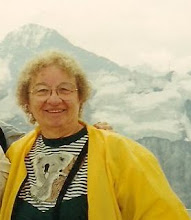
When we broke through the clouds we feasted on breathtaking views of the Alps. At the top we could see 200 peaks!. It was so clear! We walked around the 360-degree viewing platform, took pictures and couldn't stop exclaiming about the amazing beauty that lay before our eyes. My windbreaker jacket was all I needed as it really was not very cold on top.
Eventually we found our way to Piz Gloria, the revolving restaurant, for lunch. The James Bond movie In her Secret Service was filmed here in the late 1960s. The restaurant was built in in 1967.
We had a good meal at a surprisingly reasonable price. We by-passed the gift shop and simply absorbed the incredible beauty before us. Just as we were ready to catch the cable car down to Murren clouds started to roll in and when we reached the bottom the TV showed the entire area completely fogged in. How lucky could we be!

Sunday, November 11, 2012

A LESS POPULAR PART OF COPENHAGEN


Copenhagen's University District and Latin Quarter

          At the end of my Danish biking trip we spent a couple of delightful days in its capital, Copenhagen. As we headed toward  the university during a walking tour of the city  the guide told us, “In 1801 Denmark had the second largest navy in the world and Lord Nelson wanted it. Denmark said, ‘No’, so in 1807 he returned to bomb the church and much of the city including the university and library. The old university buildings that survived date back to the 1400s.”
            The Latin Quarter, an area near the university is where priests and professors once lived. It is so named for the Latin scholars, not the Latin people. Today many of these 1600s buildings are used as college dorms . Most are built as a square with a small driveway on one side leading into a center courtyard.
King Christian IV built a large round tower in the Latin Quarter. One can walk to the observatory at the top for a magnificent view of the city. Gold letters on the side in Latin, Hebrew, and Danish translate to: ‘lead the crown into wisdom and justice’.
Our walking tour ended at the Amelienborg Palace where there is a large bronze equestrian statue of King Fredrik in the center of the courtyard. The statue took 22 years to make and a year and a half to put in place. It also cost three times that of the palace and took 23 days to bronze!
The guide continued, “This palace was built in 1748 by order of the king, originally for four wealthy and influential businessmen. The architect made the exterior of all four buildings the same; however, the interior of each has been individualized. After the previous palace burned, a little arm twisting took place, and the whole compound was given to the royal family.
"The royal family has occupied the palace since the 1700s.      Queen Margrethe lives in the mansion on the right and the prince occupies the adjoining one. The Queen Mother lives in the next one and the fourth is used for important official occasions.”
The palace square is large enough to hold 35-40,000 people. We were fortunate enough to be winding down our city tour at the palace just minutes before the changing of the guard. It was a pretty impressive ceremony. I was lucky enough to watch the changing of the guard a second time on another trip to Denmark. 

Wednesday, November 7, 2012

KIEV, UKRAINE


A Visit To Kiev

We found Kiev a delightful city although definitely not a pedestrian friendly city. Crossing the street can be hazardous to your health, as pedestrians do NOT have the right of way. Fortunately there are many under the street tunnels and one should use them when possible.  
I don’t know why everyone wants to add THE before Ukraine. We don’t say the Canada, the Cuba, the Poland---you get the idea—but for some reason everyone thinks it’s the Ukraine. I shared a table in Winnipeg, Canada a few years ago with a charming Ukrainian who enlightened me.
Ukraine, slightly smaller than Texas, is Europe’s second largest country, and the largest country and most populous and developed republic of what once was the Soviet Bloc or USSR.  Russia dominated Ukrainian history for centuries, but Ukrainian culture stretches even farther back in history. The country was the center of the first Slavic state, a powerful nation called Kievan Rus, which dominated Europe in the 10th and 11th centuries.
The city of three million people seemed like a small large city. The girls are gorgeous, have long skinny legs that are emphasized with 4-inch heeled shoes topped with tight blue jeans. It is a city of young people. Streets are wide, traffic heavy. The city is full of art nouveau buildings, Stalin-era buildings that generally had a large star on top, 80 churches and numerous well-preserved buildings. We saw no decaying buildings. There are gold domes everywhere you look. The city has many 11th century buildings, yet Kiev is both the modern gateway to Ukraine and a historic town that blends commercial streets with modern byways with its old town. The seat of government, the city was very clean.
One afternoon we walked down town to Independence Square.  Kiev’s main business district, Khreshchatik, was blocked off for the holiday so we strolled down the center of the wide street lined with large old trees and grand monumental buildings interspersed with small shops. Food kiosks were being set up to accommodate the anticipated crowd later in the evening. The evenings were long with darkness not falling ‘til nearly midnight.
  Independence Square was the site of the Orange Revolution when the presidential elections were so hotly contested. Many young people in the square were smoking. Beneath the square is a huge underground mall where we found expensive boutiques and upscale western shops. A bit weary we stopped in a cafe for some people watching and ice cream.

Sunday, November 4, 2012

PALADARE EXPERIENCE


Our Last Havana Evening 

Our last evening in Havana we all elected to visit a paladare, meaning palate, for dinner. A paladare is a private home where food is served to small numbers of people. An entrepreneurial endeavor they are quasi-condoned by the government. They cannot hire help, but relatives may help out. There is a license fee, which we were told is quite high. The food is usually better than in restaurants.
The one we visited was a large mansion with dining on an outside covered patio. Everyone at my table had Cuban pork, which although delicious tasted nothing like pork as we know it, black beans,  rice and a fresh salad. We did not have time to stay for desert because  we needed to get to the Hotel Nacional (1930) to see the Buena Vista Social Club. Our cab driver took a long round-about route to the hotel, but we did make it on time and was seated well before the show began.
The Buena Vista Social Club puts on one performance a month and we happened to be in Havana for the November show. Not having seen the movie, I knew nothing about the show, but decided to go anyway. During intermission we checked out the recently renovated lobby of the famous old hotel. Then strolled the lovely grounds to admire the royal palm lined entrance and lovely tropical landscaping.
When leaving, we hopped into one of the cute little yellow  cococabs standing outside the hotel for the ride back to our hotel. It was a fun ride up the Malecon. (coastal drive or ocean boulevard) The ocean was splashing spray over the sea wall and periodically we’d get sprayed. Almost back to the hotel a cab passed on the right splashing enough water to short out the motor to the cococab. The driver struggled until he probably flooded the motor. Since we were less than a block away and could see the hotel, we paid him and walked the rest of the way.
It had been a fun evening.

Wednesday, October 31, 2012

EDINBURGH, SCOTLAND


Some Edinburgh Highlights 

This city of 500,000 is Scotland’s jewel festive epicenter of Scottish culture, as well as an important financial center of the United Kingdom.    Locals call themselves Edinburghers.
Edinburgh has been Scotland’s capitol since the 12th century. Framed by rolling hills and the blue of the Firth of Forth, it is one of Europe’s fairest cities. Half medieval and half Georgian it is often referred to as to as the Athens of the North. In 1999 Edinburgh became the seat of the Scottish Parliament. Filled with history, battles, kings, bold ideas and literary association the city is the gateway to central Scotland. It is a city of contrasts where the past meets the present and ancient streets are filled with the hustle and bustle of modern day city life. Scotland aligned itself with France in 1513, and England burned the city but spared the now famous castle.
In the 12th century Edinburgh was a walled city. The 1707 Act of Union with England moved the power to Westminster. The city is divided into Old Town and New Town. Edinburgh University was founded in 1583.
The seat of centuries of Scotland’s colorful and turbulent history Old Town is best seen on foot. The backbone of Old Town is the famous Royal Mile where kings and queens traversed for centuries. Grassmarket, south of the castle, is where the dreaded gallows hanged convicted criminals and burned witches at the stake.  Many squares, terraces, circuses, wynds and closes crisscross the city interrupting the cobbled streets thus making street numbers very confusing and difficult to find. Numbers are often missing, and follow no logical sequence.
James Craig, only 27 years old, designed New Town with its classical grid design that was the first in Europe. The buildings are Georgian. After New Town was built Old Town became a slum and remained so until a 19th century restoration. Taxes were based on the number of windows in a house, so it is not unusual to see artificial windows on the top floor that reflect no light. New Town dates to the 18th century, the golden age of Edinburgh. Three main streets: Queen, George, and Princes run parallel in the Georgian masterpiece. The rectangular symmetrical grid links Charlotte and St. Andrews Squares.  The first building went up in 1767 and by 1846 Edinburgh was a true British city with a direct rail link to London. Rose Street, directly north of Princes Street, has more pubs per square block than anywhere else in Scotland. Shops and restaurants are nestled between the pubs.  New Town covers one square mile and contains 10,000 buildings that are listed for architectural merit. (The equivalent to our historical building.)
St. Giles Cathedral, Scotland’s principal church, has a turbulent religious history. It was Episcopalian twice. John Knox delivered fiery Presbyterian sermons here that drove Mary, Queen of Scots into exile.
Robert Lewis Stevenson lived at 17 Heriot Row from 1857 to 1880. A sickly and lonely child, he spent a lot of  time in a third floor bedroom window looking out onto the street. A local wealthy citizen who turned into a sort of cat robber in the evening was the inspiration for Stevenson’s Jeckle and Hyde. The lamplighter who came by each evening to light the street lamps inspired his famous poem The Lamplighter.
The Walter Scot Memorial looks like a church spire without a church. In the middle of Princes Street by the park it really is a monstrosity looking very much out of place. Built in 1844, it towers 200 feet over the sidewalk. Inside the spire is a marble statue of Scot sitting in a chair, his favorite dog sitting beside him.
Holyroodhouse, also spelled Holyrood House, was originally built as a 12th century abbey, ruins of which are visible from the courtyard.  A little history: Queen Margaret eventually became Saint Margaret. She was very altruistic, doing kind deeds all the time, but not so her son, King David.  One day he was thrown from his horse and suddenly was confronted by an angry stag. When he put his hand up to protect his face the stag turned and walked away. He took this as a sign to change his ways and built the original fortified house down in the valley. The house was built in two sections. Mary, Queen of Scots, occupied the 16th century tower. In the 17th century additions were added to join the other buildings and form the inner courtyard. The ceilings inside were absolutely exquisite. Made of egg white and horsehair they were as fine as any plaster ceiling. The detail and design was incredible. This would not be my choice of residence and it is said that the Queen detests Holyroodhouse. 
There you have some highlights of Edinburgh.


Sunday, October 28, 2012

GLORIETTA


Finally Made it up the Hill

            On my third visit to the Schönbrunn Palace I finally had the time to hike up to Glorietta. Built in 1775, Maria Theresa decided the Glorietta  be designed to glorify Habsburg's power. The Baroque Schönbrunn  was to be so beautiful it would rival France’s Versailles. Having visited Versailles just a few months before this visit to Schönbrunn, it was easy for me to more or less compare the two palaces. I vote Schönbrunn to be the most exquisite. Since 1918 it has been property of the Austrian republic.
            Schönbrunn was the summer residence of Habsburg rulers. This is also the palace where Mozart performed for the Empress and her guests when only 6 years old. It  is said that after his performance he jumped onto the Empress’s lap. 
            After walking the rose garden and part of the maze admiring the lovely greenery I wanted to head to Glorietta. We walked back to the wide floral mall area and strolled to the huge Neptune  fountain.  My new traveling partner was hot and tired, so I left her sitting in the shade while I took the trek up the steep hill to Glorietta. It was a slow, careful climb up and down because of loose pebbles from frequent gully washes of recent rains. I thought I did not need to turn an ankle at the end of the trip!
            The view from the top was magnificent. Built on the hill behind the palace, it is the last building constructed in the garden. The temple of renown was to serve as both a focal point and a lookout point for the garden. It served as a dining hall and festival hall as well as a breakfast room for Emperor Franz Joseph I.    The Glorietta was destroyed in the World War II, but restored by 1947. Nothing remains behind the façade except a space that serves as a courtyard containing decorative sculptures. It was a beautiful sunny day and I took my sweet time enjoying the view.
            We had discussed having lunch in the gazebo at the zoo, but my cranky friend wasn’t hungry at noon so we headed to the subway and back to Vienna. 

Wednesday, October 24, 2012

BELGRADE, SERBIA


City Impressions

            Cruising into Belgrade, Serbia early in the morning, we gazed upon the green terraced lawns of the castle facing the water. The city looked more prosperous   than anything we’ve seen, and the apartment buildings looked relatively new---a nice change from the communist buildings of the previous couple of days. 
            Our local guide met us at the pier on the Sava River and while walking us up to the fort she said, “Turks occupied this area for 500 years, and there was no Serbia on the map. You can see old walls here in this part of the fort. The Turks used bricks and the Austros used stone so it is easy to tell who built what. Over here are some old Roman ruins which date back to the 4th century. Over the years two million Serbs died fighting for freedom, and the Turks were finally defeated in 1867.”
             Located at the confluence of the Sava and Danube rivers, Belgrade has always been on the important east--west trade route serving as a gateway from the Balkans to Europe. Belgrade, whose name translates to white city, has a 2500 year history, is Serbia’s capital and the country’s largest city. It also was capital of the old Yugoslavia. . One of Europe’s oldest cities, it is the center of the country’s political and cultural life. After years of repressive communist rule, the country is just emerging into the tourist market.
Conquered and rebuilt by Celts, Romans, Slavs, Turks, and Austro-Hungarians, the Kalemegdan Fortress anchors the city to its strategically important position. Belgrade suffered heavy damage during both WW II and again in the Kosovo war of 1999. The city has been razed to the ground 44 times while involved in 115 conflicts/wars!     The old battleground,  is now a peaceful retreat from a bustling city. From its walls one can see the modern regional economic center and the hi-rise buildings of New Belgrade rising across the river that give one a feel of the importance of this crossroads-city.
The fort has four walls and three gates. The outer moat has been filled in and now houses tennis and ball courts. The inner moat, also filled in, displays military equipment. The huge park is shaded by many old trees. The fort covers a very large part of the city and also houses museums and a zoo on the grounds. There are seven miles of tunnels under the fort, and like many old cities, Belgrade has an upper town and lower town.
One outside wall of the zoo (1936) displayed art work of animals done by school children. They were colorful, all the same size and made a most unique cheerful wall. From the fort grassy area we had a good view of the Victor Monument. Erected in 1928 it represents all Serbian fighters of WW I. Originally the monument was to be in downtown Belgrade, but the warrior is naked and the residents just would have no part of a naked man overlooking the city, so he faces the river. He holds an eagle in his left hand and a downward pointing sword in his right.
It was a Sunday and we spent the afternoon walking the large shopping district/mall. It was a lovely sunny day that had many families out enjoying it. People were very friendly. We stopped to watch various street performers and did a bit of shopping at some of the sidewalk vendors. Most of the numerous upscale stores and boutiques were open. I was impressed with the city and would have liked a bit more time to enjoy it.

Sunday, October 21, 2012

THE GROTTO in LUGANO

                      Interesting Restaurant Experience

Lugano is the Italian part of Switzerland. The climate, geography, homes, language all are entirely different from the rest of the country. My travel buddy on that trip wanted to extend out stay and visit Lugano, and that was fine with me. Our guide  insisted that we should visit a certain grotto restaurant. He drew us a map, gave us directions and assured us they spoke English and accepted credit cards.
We were game. We took the city bus to Paradiso and walked the short distance to the gondola station to get to the top of  Mt San Salvador. We had a spectacular view and after walking a footpath to an old church and climbing a flight of stairs to the observation deck we had an even better 360-degree view above the tree line of the city and lake.
Back at street level we found our way to the post bus stop where we had a short wait for the bus. As we boarded the bus I showed the driver a card from the restaurant to make sure we were on the right bus.  Little did we know we were in for a hair-raising ride over a narrow switch-back, hairpin-turn road up, up, up! At one narrow overpass the driver had no more than an inch of space on either side of the bus. He was good!
The driver alerted us at the proper stop and pointed us in the right direction. It was a Saturday and we never thought to ask when the bus returned. We followed the cobblestone alley for quite a distance and I was beginning to wonder if we really were in the right place when around the next curve the grotto restaurant appeared. 
English—forget it. No one, even the other diners, spoke any English. The menu of course was in Italian, which neither of us spoke.  We had been told to sit at a stone table, but for the life of me I can’t remember the significance of why. But we did it anyway. We could figure out pizza and salad on the menu. I opted for the former and my buddy the latter. Both were good, but we were a bit surprised when the tomato salad arrived and  a large bowl of quartered tomatoes was set before us!. The setting was lovely, cool, picturesque with flowers and greenery everywhere.
We paid our bill and made our way back down the alley. The bus schedule was posted on the outside of the post office. It was a bit confusing so I walked next door to another restaurant and found an English-speaking gentleman who informed us the bus was due in five minutes; then the next and last bus would be 3-hours later.  Talk about unexpected good timing!
After an equal hair-raising ride down the mountain we were happy to be back in Paradiso where we decided to walk back along the waterfront to Lugano. It had been a fun day.