Sunday, August 19, 2018

THE BIG BANG


                                                 A Terrible Accident
      Not be confused with the popular Big Band Theory of TV fame; this big   bang took place during WW I in Halifax, Nova Scotia.  This huge explosion happened in 1917 when the harbor was teeming with war ships transporting troops, supplies and munitions to Europe.
     The Narrows, appropriately named, is at the head of the harbor.  The French ship Mont Blanc was on her way out of the harbor carrying munitions ---400,000 pounds of TNT destined for Europe. The Belgian ship, Imo, had been diverted to Halifax and was sailing into the harbor.
     The Imo maneuvered a bit off course to go around a tug boat, then found herself directly in the path of the Mount Blanc. Horrified, both ships immediately went into reverse which swung their bows into each other causing a spark that set the Mont Blanc on fire.
     Aware of their cargo, the Mont Blanc  lifeboats were immediately lowered into the water and the Mont Blanc crew headed for Dartmouth on the opposite shore.  People gathered on shore to watch the burning ship drift toward Halifax.
     Those in the life boats kept shouting to the people on shore to go back over the hill, but the spectators did not understand French.  Once on shore a quick thinking sailor grabbed a baby out of its mother’s arms and ran up the hill. Of course everyone chased him, but that simple act saved many lives.
     In just twenty minutes the ship exploded with a vengeance destroying the entire north end of Nova Scotia.  It was the largest man made explosion before Hiroshima.  The Halifax explosion instantly killed 1800-2000 people and injured another 9000.
      A wire sent to stop a troop train heading to Nova Scotia instead made it to Boston. Only two hours after the explosion a medical relief train was ready to leave Boston.  A massive international relief effort followed to rapidly rebuild the city.
     In gratitude for the help Boston rendered during that awful time, Nova Scotia still, decades later, sends a large spruce tree for public display to Boston every holiday season.

Wednesday, August 15, 2018

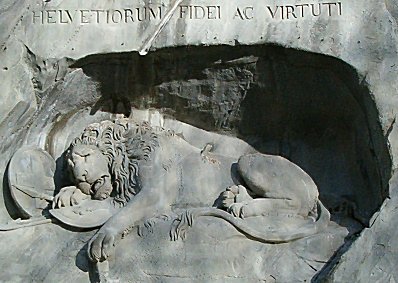
LUCERNE'S LION


                                          Famous Swiss Monument
      In Lucerne, Switzerland I fell in love with the country’s famous Lion Statue. Each time I’m in the city I have to visit one of the most famous monuments in the world.
     During the French Revolution 40,000 Swiss served under foreign banners. When a man retired, his son inherited his father’s commission, and the Foreign Legion was big business in those days.
Lucerne: Lion Monument - HELVETIORUM FIDEI AC VIRTUTI     Swiss mercenaries were killed in 1792 on the Tuileries Palace  steps while defending King Louis XVI. About 25-years later, in 1819, in Rome, Bertel Thowaldsen designed the lion as a tribute to his  fallen Swiss countrymen.  
   Lucus Ahorn was commissioned to be the carver. In 1820-21 when he carved the monument out of a sandstone hillside, the area was in the countryside, well away from the city center.  Today the six-meter (19.5 feet)  high and 10 meter (39.5 feet) long monument is in the center of  Lucerne. An arrow protrudes from the lion’s back, a tear runs down his cheek, and a paw lies across the Swiss shield, protecting even in death.The powerful larger-than-life memorial brings tears not only to my eyes, but to nearly everyone who sees the wonderful statue.

Sunday, August 12, 2018

ENGLAND'S WHITE HORSES


                                                  Old Hillside Art
      During visits to England I learned about and saw several large white horses carved into hillsides.  A school teacher carved the first horse in 1856 in southern England.  Such carvings are quite common throughout  the countryside.  Because the soil is chalky and relatively soft in southern England, many horses can be found in this area. There are 16-17 hillside carved horses around the country.
     On the way to Bath, just before leaving the chalk region and shortly before arriving in Bath, the guide called our attention to a horse carving, saying, “This horse is over 80-feet long and is known as the Westbury horse.  About 200 years ago the horse was recarved and enlarged, but the sad thing is it encompassed a horse carving that was 1000-years old, and the original carving is now lost forever.”
     One exception to the chalk horses is the 1857 Kilburn white horse. The huge horse located in the North York Moors National Park in Yorkshire  measures 206-feet by 320-feet long. It is said to be the largest and northern most of England’s horses.  A steeply graded road leads to a car park and a foot path that leads one along the cliff over the horse.
     During WW II the horse was covered to avoid it being a target for enemy bombers.  It is carved out of granite and periodically has to be painted white by men hanging over the cliff by rope and using paint rollers.  (I’m not sure if this is a folk-tale or not.) Apparently  there are some chalk chips imbedded in the horse.
    However, I mused that it must be quite a sight to see grown men hanging over a cliff painting the hillside.

Wednesday, August 8, 2018

UNEXPECTED STRIPTEASE


                                        A Secret Striptease
     When I arrived in Yorkshire, England the weather had turned considerably cooler, so for the first hike up the moors I decided to wear my silk long johns under my light weight slacks.
     Because of the literary history and fame of the area I was excited and was hoping to see some heather on my first moor hike. It was over 1000-feet straight up to the top of the moor.  However we zig zagged over a switchback path through pastureland and open fields during the 2-3 hour climb. The rather cool wind made me realize I’d made the right wardrobe choice in the early morning.
     At the top the wind was so strong that I thought it might actually blow over one little lady in the group. But on the other side of the moor it was much warmer and practically windless on the sunny day, so that is where we sat to eat our lunch. After lunch our guides tried to teach us some sort of a ball game popular in England.
     The hike down the moor was over a relatively smooth ‘farm road’ with a gentle decline.  Later the guide told us that most groups are taken up over the road, but they thought we were fit enough for the more rugged climb through the pastures. None of us complained!
     With the wind gone and the sun high in the cloudless sky I began to get warm and started thinking about how I was going to get those long johns off.  About half way down we stopped to visit an ancient church.  I entertained  removing those  silkies in the  crypt, but on second thought maybe not. Back up from the crypt and outside I decided the cemetery was the perfect place for a striptease!
     Sitting on a large tombstone just off the main walkway I slipped off one boot and quickly removed my leg from both  the silky and trouser leg, shoved my leg back in the trouser leg and my  foot into my boot. Then I repeated that process with the other leg. Quickly I balled up  the long johns and shoved them in my pocket,  retied my boots and was ready to move on. Quick as a flash I had performed my striptease with no one aware of what I was doing.
     Back on the road, after a bit I reached in my pocket to pull out a bit of my silkies and poked my friend in the arm saying, “Look what I’ve got.”
     Amazed she replied, “How did you do that?”
     “I'll  never tell,” I giggled.

Sunday, August 5, 2018

A SCARY ARRIVAL


                                                  Scary Arrival
     Most flights to Central and South America arrive in the evening which means one usually arrives in the dark. Before I went to Peru I read that violent crime was very low but in major cities pickpockets and slash-and-run activities were rampant.
    Although securing a taxi inside the Lima airport  was more expensive than outside, it was highly recommended because of safety and reliability factors. Approaching the taxi counter I confirmed the price from the airport to the suburb of Miraflores.
     Our driver clad in a suit and tie spoke almost no English, so I showed him the name of the hotel and address printed on a piece of paper.  Yes, yes he understood.
     Like many places I’ve been, driving Lima is like playing a game of .chicken.  Honking horns are a constant, and thank goodness the cab had good brakes!  Traffic lights were few and everyone ignored the few stop signs.  I had noticed the cab had no dents which was a plus and a bit of a comfort.
     On the edge of the city we rode through barrios where disheveled people, mostly men, stood in groups on street corners smoking and drinking.  I said a silent prayer for no vehicle mishap, an accident or flat tire.
     It was a relief to leave the barrios, but then we were on a paved two lane winding road that appeared to be following the coastline or a body of water.  There were no street lights or any sign of buildings, and it was very dark.
     Were we on the right road?  Would we be robbed, ambushed or worse?  Would we be dumped with no idea where we were and unable to speak the language beyond a little pidgin Spanish?  All kinds of scenarios flashed across my mind.  I was nervous and very quiet on that ride, as was my son in the front seat.
     Suddenly the bright lights of Miraflores appeared.  The area of neat homes and well-kept yards was a welcome sight. A sigh of relief escaped my lips when I spotted our hotel. While I was paying the driver, my son off loaded the luggage and before I could turn around, hotel staff had whisked our luggage inside.
     In retrospect, it was probably a very pretty ride in daylight, but in total darkness it was very scary indeed!