Wednesday, November 19, 2014

LEONARDO DA VINCI

                                              A Fascinating Man

Picturesque Amboise, France built up around a fortified chateau.  We hiked up a long steep hill to reach the manor house of Chateau du Clos Luce, built in 1471 over a 12th century foundation. We entered the small manor house by climbing up a narrow spiral staircase in the tower. The pink brick and tufa stone bear the architectural mark of the 15th century. The summer home of French kings for 200 years, the chateau is surrounded by acres of woodland park.  Da Vinci was free to dream and work here.
I quote from a flyer: Leonardo da Vinci’s last residence, the Château du Clos Lucé, is dedicated to conveying an overall picture of the art and the boundless vision of the Tuscan artist. From civil and military engineer to botanist, in his work as an architect and as a musician, the all-encompassing nature of Leonardo da Vinci’s intuition is brought to life before your eyes.
The interior of the manor house shows the everyday life of Leonardo da Vinci and his 40 fabulous machines. It was here at the Château du Clos Lucé that da Vinci, at the invitation of the King of France, Francis I, spent the last three years of his life. He brought his famous Mona Lisa with him. From 1516-1519 he spent time perfecting his many inventions before passing away on 2 May 1519. 
             The royal Chateau d’Amboise sits higher on a hill a few meters from the Clos Luce where da Vinci lived. The two buildings are connected by an underground passageway. There are several models of da Vinci’s inventions in the house. Except for his bedroom the house was unremarkable. He slept in a Renaissance canopy bed with maroon drapes.  It was a beautiful warm day. Once though the chateau we headed out into the woodland. 
The wellsprings of Leonardo's inspiration is punctuated by 16 giant and actionable machines, 32 transparent canvases (3 to 4 meters high) depicting the Master's sketches or details of his paintings, and 8 sound stations featuring the voice of the celebrated French actor Jean Piat.  The display of his early inventions was astonishing. We wandered and saw most of the park and arrived at the water retrieval machine just as it went into action.His inventions were numerous and displayed in a very understandable way for us with a lesser inventive and imaginative mind. I don’t even have the notes to describe many of them. There was so much to see!
When my friend tired of walking the park we returned to the manor house and sat awhile in the small garden. We babbled on excitedly about the genius of this man who generally is known for his painting. We were both stunned to learn so much about this man. It seemed, besides the large number of huge chateaux, the Loire Valley had a surprise in each one and on every country road.
A formal French garden goes back to Louis XIV.  French gardens are more sculptured than English gardens and no bush is higher than 3 ½ feet tall. Louis didn’t want anyone hiding. French gardens also have less color.

Sunday, November 16, 2014

RECENT VISIT TO EMBREA

                            Civilization is Encroaching 

            I thoroughly enjoyed my visit to an Embrea village 17 years ago. The hour ride up the Sambu River through the Darien Jungle was a delight early in the morning. It was authentic.
            Progress sometimes makes me sad. I’m not sorry I made a visit to another village  recently, as it was a chance to introduce my grandchildren to an entirely different life-style. But seeing ‘civilization’ encroaching on the native tribal customs gave me pause.
          This village was easily accessible as it was located right on the river bank, close to our rainforest hotel. American capitalism had built concrete steps and iron rail from the river edge up into the village. I appreciated the easy access, but couldn’t it all have been done in a more rustic approach
to blend in with the village? And really did we need to have a toilet installed near the main structure? If a toilet was such a necessity how about a low profile chemical one. Give me a break!
New Construction
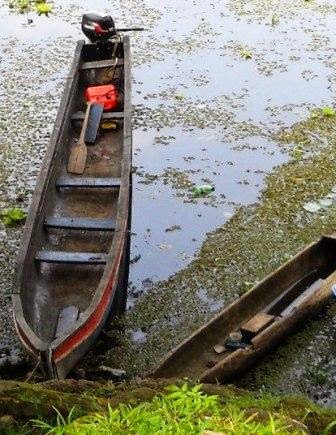
       Women now covered their torso with a beaded minimal halter top. I noted a new motor boat in the back of the village—however a native cayucu was pulled on the shore in the front of the village. A new building under construction was large, had ordinary steps and obviously lumber from the lumber store was being used. Maybe because trees are not supposed to be cut in the rainforest---I’d like to think that was the reason, but it did seem the building looked out of place with its metal instead of thatched roof!
         I would guess that fast food had entered their diet as their bodies were hardly lean. They obviously understood a good deal of English. Their handicrafts are still well made, but many tourist-type trinkets have been added, like woven bracelets available everywhere one goes.
     My daughter and I discussed these changes and I had an extensive conversation with our guide about them. If I had not made a previous trip would I have been so keen to notice the changes? Knowing me, probably, or at least questioned them. I did not mention any of the above to my 18 and 20 year old granddaughters. I did not want to spoil their excitement and adventure. 
        The small children were adorable! The girls had great fun talking to them and playing. The little ones obviously are used to interacting with visitors. I wonder when these youngsters will want to go off to a ‘better life’ and how long before the culture will just disappear. I didn’t see any cell phones, but that doesn’t mean they weren’t there. Sometimes progress just makes me very sad!


Wednesday, November 12, 2014

THE EMBREA PEOPLE


                                    An Interesting Culture
            The name Embera means people. Collectively they are known as the Chocó and belong to two major groups: the Embera, of upper Atrato and San Jaun Rivers, and the Wuanana of the lower San Juan River.. The Darien Jungle is the second largest rainforest area in the world (after the Amazon) and 20,000 Embera live in small groups in the Darien. The jungle serves as a buffer zone between Panama and Columbia. There are no roads in the wild desolate area.  There is a 54-mile stretch called the Darien Gap of the Pan-American Highway that is impassable. Cars have to be shipped.
            Some Embera live in the Canal Zone and can do so as long as they do not hunt or cut down trees. Originally the tribe was hunter-gatherers, but today they live on jungle fruits, heart of palm, and tubular plants such as yucca and fishing.
            The Chocó, or Embera people live in small villages of 5 to 20 houses along the banks of the rivers throughout river watersheds in the Darien Province of Panama. There are generally three villages, about a half day's walk apart, on each tributary that branches off from the main river system. The villages are built on a small rise, set approximately 100 feet in from the river. To avoid wild animals such as peccary and jaguar from inhabiting the homes, houses are built on posts 6-8-feet above ground and are 20– 50 feet apart. The raised floor also gives protection from flooding and allows for cooling of the hut. There are no walls on the palm fond thatched roof huts. The joinery is done with bejuco vines.
            Baskets, pots, bows and arrows, mosquito nets, clothing and other items hang from the beams. They sleep on the floor. The floor is made of split black palm trunks or cana blanca (white cane), and has a kitchen built on a three foot square clay platform that forms a fire base for cooking. A sloped log with deep notches for a ladder provides access to the hut. The notches are faced down at night.
           The jungle is partly cleared around each village and replaced by banana and plantain plantations, a commercial crop for them that provides  cash for their outboard motors, mosquito nets etc. The hills leading down to the river are usually hard packed reddish clay.  Dugout canoes are pulled up on the riverbanks
The land is community owned and community farmed. Everyone in the village pitches in to work at harvest time. The tribe farms and both men and women work in the fields. Women carry corn and grain, but the men carry the firewood.
If one hunter gets a larger animal, such as a peccary, or a tapir everybody shares the meat. These Indians live separately in the jungle. These people are very individualistic and totally apolitical. You deal with them one on one. The Embrea use a flute and a drum to keep beat for their simple dances.
            Small in stature, their skin is a pretty bronze. Health care primarily is provided by trained Shamans. The men wear nothing but a minimal loin cloth. The women wear bright sarongs wrapped at the waist as a skirt. Women generally do not cover their torsos, but wear multi strands of seed beads and wear long straight black hair. The children go naked until puberty, and no one wears shoes.
            They paint their bodies with a dye made from the fruit of the black palm tree. The black dye is thought to repel insects. On special occasions, using this same dye, they print intricate geometric patterns all over their bodies, using wood blocks carved from balsa wood. The paint fades in a few days and is known as the two-week tattoo. The women also wear silver necklaces and earrings on special occasions; many of the necklaces are made from old silver coins. A hole is punched  in the coin and a silver chain run through it. Many of the coins on these necklaces date to the 19th century and are passed down from mother to daughter.
Women weave baskets from leaf strands of the black palm. The tightly woven watertight baskets are called canastas.
The men do some rather good wood carvings from rosewood, known locally as cocobolo. They also carve small figures and animals from the vegetable ivory nut known as tagua. Until 1936 many buttons were made from this nut. The nut is about the size of a small plum, hard, and rather difficult to carve. When polished they certainly look like ivory.
Embera  dances reflect their spiritual connection to nature.
            The Embrea people use matrilineal descent, practice polygamy and live in family units. They have their own form of government and live by their own unwritten rules avoiding the Panamanian Police or any other branch of the Panamanian or Colombian government. Not assimilated into Panamanian or Colombian society, the Embera people do not hold any civic positions and have no members who have become part of the Guardia Nacional in Panama. They do not intermarry with Panamanians and Colombians.