Sunday, April 8, 2012

AN UNUSUAL CHURCH


                                               A Small Country Church

When biking in Germany and Austria between Melk to Krems we stopped in the small village of St. Michael to visit a rather unusual church. Our guide  told us. “This hilly area is wine country. You can see the vineyards are terraced as space is at a premium. The cemetery is very small, but 11,000 people have been buried here. In order to accommodate that many people, eventually skeletons had to be dug up to make room for more recent burials.”
            What did they do with all the old bones? In a room in the back of the church they created an altar with the old dug up skulls. It was pretty eerie. A large wire bin was full of long bones—those from the arms and legs. The whole room was really spooky.
            A docent informed us, “Many years ago churches were built as fortresses to protect the village from invaders. This church originally had five towers, but only one remains today, and the gun turret is clearly visible. Also in those days people didn’t have money to pay for services so they paid in produce, eggs, chickens, or whatever  they had. As a result this church had a nice wine cellar and two rooms to keep smoked meats cool.
            “This church in St. Michael was closed from 1784-1950. In 1950 it took the residents three years to clean up the inside of the church as birds had been nesting within for over a century and a half. You can’t  imagine what a  mess that was!  In 1965 the church was renovated. The alter came from another church and is really too big for this small church. Only a few church services are held each year, but many weddings and concerts are held here.”
            An interesting if spooky visit. Not too long ago I picked up the end of a TV program that featured a similar skull room, but I missed where  it was, other than the fact that it was not the church I had visited.


Wednesday, April 4, 2012

SEA OF CORTEZ

           Islands off Mexico

The Sea of Cortez in Mexico wasn’t even on my radar until a friend called looking for a roommate and travel companion. This would be a primitive camping trip and my friend knew no one else willing to sleep on the beach in a pup tent. She figured I’d be game.
After arriving at LAX  I learned we were being weighed and limited to one small carry-on bag. I found a couple empty chairs to do a little repacking before checking in. Fortunately I’d stuck a backpack in the outside pocket of my suitcase. I pulled a change of clothes, nightgown, bathing suit, tee, mask, snorkel, and cosmetic kit out of the suitcase, put it in the pack and was good to go. In case the luggage didn’t arrive with me at least I could cope.
            On arrival in La Paz our guide told us, “The Sea of Cortez spans nine degrees of latitude crossing the Tropic of Cancer at the southernmost tip. The diverse landscape provides for a variety of cultures and ethnic groups. The shores of Baja’s Pacific coast vary from the shores along the Sea of Cortez. There are many resorts along the shores of Baja for those who enjoy that sort of comfort and travel, but the 53 uninhabited islands and the many rock outcroppings in the Sea of Cortez provide adventure and real variety. We will be camping on Isla Espiritu Santo, one of the larger islands in the southern part of the Sea."
            Espiritu Santo is approximately 25 miles from La Paz and a 2 ½ hour boat ride. When arriving at our beach the azure blue, clear water was too shallow for the boat to get very close to shore, so the captain dropped an anchor over the side and we loaded pangas (small outboard Zodiac-type motor boats) for the trip into the beach. The 6 X 8 tents housed two people. You can imagine the calisthenics we performed when getting out of a wet bathing suit!
            We retired early after the evening programs, but the gentle lapping of the waves on the beach soon sent me off to dreamland. I woke with the sun and each morning my friend heard me say, “What a treat to wake up to fresh steaming coffee and a hot breakfast. This is the life!”
            Our cook produced wonderful meals. Food always tastes better when eaten out doors, especially when it is prepared for you! The island was our home port for ten days and we had a wonderful time with lots of adventures.

Sunday, April 1, 2012

LOVELY MOUNTAIN ACCOMMODATION

                                                Inland Belize

           After our dolphin project on the Belize atoll I decided to stay over  on the mainland to see some Mayan ruins. We traveled about 20 miles on paved road through the rural countryside. Although the road was paved it had no dividing lines, and there was very little traffic after the first five miles.
            Then we turned onto a dirt road for about another 20 miles. Our four wheel van progressed slowly dodging ruts and holes in the road. It was also a gentle climb to about 2000 feet. In the valley we passed huge citrus farms. The pine trees were tall and straight, slightly smaller than a telephone pole.
During the ride the driver told us, “The Mountain Pine Ridge here  in the southwestern part of Belize has some of the most diverse scenery in the country. These stately pines cover 300 square miles of steep hillsides in the foothills of the Mayan Mountains. Along the edges of the pine ridge are limestone caves, white water rivers, hardwood forest, and sharp escarpments with sweeping views. The climate is slightly cooler than the rest of Belize. Birds are plentiful, butterflies are particularly numerous, and there are many varieties of unusual bromeliads and other epiphytes. Much of the wilderness is in virgin condition, just as it probably was 2000 years ago when the Mayans left their footpaths.”
We were headed to Blancanceaux Lodge which happened to be owned by Frank Cuppola. The beautiful tropical landscaping was a surprise. We stayed in a lovely thatched roof cabana with a nice screened veranda that afforded us a spectacular view of a waterfall in the Privassion River beyond. All the electricity for the lodge was generated from a small facility on the river.
I spent the afternoon hiking around the area and enjoying the lovely landscaping. It was a quiet, peaceful afternoon.
The rainy season normally starts the end of May but that year the archaeologists left the area in mid-May, two weeks earlier than usual. This was not a good sign! 
 That night I fell asleep listening to the running water of the river behind our cabana not knowing if we would make it to the ruins in the morning. Would the weather let us attempt the trip? (Yes , we woke to a thumbs up, but more about that later.)

Wednesday, March 28, 2012

Galapagos islands


Tower Island and the Birds

Tower Island in the Galapagos is nick-named the Islands of Birds or Bird Island for the millions of birds who call it home. We were lucky, as it was mating season for the masked boobies, blue footed boobies, and frigate birds.
We spent a great deal of time watching the frigate birds as their mating ritual is quite spectacular. The male inflates a pouch below his neck which looks like a huge red valentine to attract his mate. The female can sometimes be pretty choosy and dance around the male for some time before deciding this is the love of her life. After watching one couple for some time, when I left the female still hadn’t made up her mind but she was warming up a bit.
We hiked up Phillips Steps to a plateau. It was a fairly rugged climb and I was glad I was  in pretty good shape. The terrain on the top was rocky.
Boobies were mating all over the area. In addition storm petrels and swallow tail gulls were flying about. Boobies have an intricate mating ritual and they are a lot of fun to watch.
It’s interesting how certain animals inhabit certain islands in the Galapagos. That is nice for the visitor as one can concentrate on one or two animals at a time and not all of them at once. It was a new adventure, island and different animals each day. It was a fabulous trip!
 
Floreana no doubt was named because of its abundant flora. As we hiked, our guide  told us, “Interestingly enough you’ll notice all the flowers on the island are either white or yellow.  That is because only one variety of bee does all the pollinating.”
We hiked a sandy path through lush vegetation. Our destination was a brackish lagoon, home to over a 1000 flamingos. We were told, “You’ll notice all the birds are on the far side of the lagoon away from any trespassers. They don’t like anything taller than they are so you need to squat while you watch them.”    We spent a considerable time watching them.
Leaving the lagoon we hiked over some rather rough terrain to Flour Beach. It was flour
not flower. Why? The beach was a fine white powder-like sand. The beach is appropriately named. The snow white sand was quite a contrast to the brown sandy beach we landed on, yet we were on the same island. A turtle breeding ground,.prevented us from swimming at that beach.   The beach was also home to thousands of hermit crabs. It was fun to watch the little crabs scamper about and then disappear into a hole.

We went ashore at Post Office Bay. Years ago sailors would leave addressed letters in a mailbox there. They also would remove any letters addressed to their destination. When they arrived in port they would stamp and mail the letters they had taken. The custom continues today. We were encouraged to take any letters  addressed to our home town to mail them on our return home.
Every day in the Galapagos was a new adventure and each day seemed to be better than the day before. It is an unusual place and a unique vacation spot--real eco-tourism!

Sunday, March 25, 2012

ELEPHANT RESEARCH CENTER

                             All About Elephants 

While in Amboseli we visited the Elephant Research Center one afternoon. In 1972 Cynthia Moss established the Center to do the most comprehensive study of elephants ever done.
            Her palm tree oasis included four sleeping tents, a dining tent, kitchen, shower, and outhouse. Two maintenance men and three research aids were employed as full time residents in this oasis. Ms. Moss continues to head up the program.
            During a lecture an aide told us, “Droughts in 1976 and 1984 killed many elephants. The reserve now has a population of 830 identified and named elephants. About fifteen elephant babies are born each year.
            “At birth a baby weighs on average 260 pounds and stands three feet tall. The gestation period is 22 months. A baby elephant is born with two sets of teeth. Over its lifetime the elephant has several sets of teeth, the sixth set coming in at about age 40 will last 20-25 years. Eventually when the elephant can no longer eat he dies and his average life span is 60-65 years.”
            Male elephants mature at about 14 years and at that point he leaves the family. Tusks appear at about 2-2 ½ years. A family is led by the matriarch of the herd, not by a male as is mistakenly and commonly believed. Males socialize together. Babies stay with the mother. When you see a lone elephant it is usually a young male who has left the family and who has not yet linked up with others.
            A female elephant goes into estrus (fertile) only 4-6 days every four years! A male comes into musth once a year and not all males are in musth at the same time. However, a male may be sexually active even at times when he is not is musth. He is fertile when in musth and the time is definitely marked as he dribbles urine and secretes a smelly fluid from a gland behind the ear. The body hormone changes also gives him a distinctive walk.
            Adult elephants eat 300 pounds of food a day often traveling 20 Kilometers (12 miles).  An adult male weighs 12,000 pounds; a female half of that. Elephants walk in a straight line like playing follow the leader, as many animals do, especially when migrating. Their paths across the plains are 12-14 inches wide. Sometimes people think these paths are tire tracks.
I said to my son, “When you think of the size of these animals it is amazing they leave such a small track/ path.”
This was an interesting visit and I certainly learned a lot about elephants I did not know.

Wednesday, March 21, 2012

BAMBERG, GERMANY


BAMBERG, GERMANY

Bamberg, Germany dates back to 973 and the whole city is  a UNESCO World Heritage Site, which is rather unusual.   Because Bamberg had no industry the city escaped bombing in W W II, and as a result Bamberg has 2000 historical buildings and monuments.
Bamberg was the center of the Franconia before 1800. A university town with 8000 students, it is often  referred to as the town of seven hills or as the Rome of the North. The city is located at the confluence of the Regnitz River and the Danube Canal, which was completed in 1992. The canal has helped tremendously to control flooding.
The city became part of Bavaria in 1802 but being located in upper Franconia the people refer to themselves as Franconians rather than Bavarians, and feel connected to Bavaria only administratively. Today the city does have an industry that produces spark plugs and fuel injection systems.
The town was ruled by bishops for 800 years. One of the highlights of the city is the rather unusual city hall situated on an island in the Regnitz River between two sections of the city. Way back in the 7th century one side of the river was for bishops, the other side for merchants. By locating the city hall in the middle of the river with a bridge on each side, it solved the problem of neutrality. The foundation of the building is shaped like a ship’s bow as it faces small falls just a few meters upstream. The tower was destroyed in 1440 when it was full of explosives and caught fire.
I was quite intrigued with city hall both for its structure and its location. However, the gorgeous frescos on the side of the building took my breath away. The frescos on the outside of the building date to the 18th century and are in unbelievable condition. In 1002 the German King, Henry II, chose Bamberg as his residence.
Bamberg with its cobbled streets and wonderful old buildings is a quaint and picturesque town, really little more of a small village.

Sunday, March 18, 2012

ISLAS FLOTANTES

                   Floaring Islands of Peru 

The major attraction in Puno, Peru is the Uros people and their Floating Islands. Even though it is a bit over commercialized, it is popular because it is different from anything else in the world. The floating islands are 5-15 miles off shore. 
Because of intermarriage with Aymara-speaking Indians, there are no pure blooded Uros left. The original language is lost and they now speak Aymara. Always a small tribe, the Uros began their unusual floating existence centuries ago when they desired to isolate themselves from the Collas and Incas. There are only 160 people living on the islands today, with 1600 more living in Puno. The attractions of shore life beckon to the young.
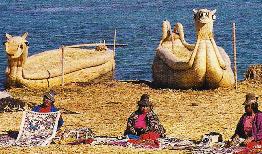
Heavy rains years ago caused some arthritic-like problems among the Uros people. Today they arrive on their floating islands early morning with their wares and leave for Puno about 4:00 PM. It is a very commercial venture now, but a very different life style. Only 3-4 people actually stay on the islands at night. Living on a floating island has its advantages. When the family gets too large or if there are disagreements in a village, a section of the island is sawed off and it floats away.  Thus, the number of islands varies, but there are generally between 40 and 50 at any given time. The blue of the lake waters contrasted vividly with the golden color of the reeds.
The lives of the Uros are totally interwoven with the totora reeds growing in the shallow waters of Lake Titicaca. The floating islands are made of many layers of reeds. As the reeds on the bottom rot, new reeds are added to the top layer, so the islands are a bit soft and spongy.  It was a strange feeling to walk on the islands which I liken to walking on a water-bed. The biggest of the islands contains several buildings including a school. Another island had a small one-room museum.
   The totora reeds are also used to build canoe–type boats. These boats will last a family about six months for transportation and fishing. We rode in one of these boats from one island to another. Much like a canoe, we all sat very still during the passage, as the water was cold and none of us wanted to land in it. I’m sure the boats are more stable than we thought. These boats have been built since 1445 and are really an art form.
The reeds have many uses on the islands. Besides the skillfully woven boats, they are the main building material for the homes. Even food is created from the pith of the reeds, which makes a nourishing asparagus-like vegetable. Some of the pith is also dried and turned into flour, for baking bread.
          Commercial fishermen have over-fished the waters, tourists are affecting their traditional culture and sewage from Puno is causing environmental and health problems. Sewage and pesticides are causing sickness as well as affecting the totora reeds that aren’t growing to the lengths they once did.
            Only time will tell how the Uros people meet the modern challenges that affect their unique lifestyle. 

Wednesday, March 14, 2012

L’ANSE AUX MEADOWS

        A North American  Viking Settlement 

At the tip of the Great Northern Peninsula of the island of Newfoundland lies L’Anse aux Meadows, site of the first European settlement in North America nearly 1000 years ago. It  is a significant archeological find. Excavated remains of an 11th century Viking settlement consisting of timber-framed turf buildings (houses, workshops, etc.) that are identical of the same time period with those found in Norse Greenland and Iceland.
Viewing the outlines of Norse encampments at the UNESCO site stimulates the imagination while replicas of Norse sod buildings provide the stage for costumed interpreters to help one imagine what life in the harsh environment was like centuries ago.
            Our young Parks Canada guide told us, “Dr. Ingstad, a Norwegian, spent half his lifetime finding and working on this site, which he discovered in 1960. Unexpectedly a local fisherman told him about this place when the doctor asked if there were any strange or unusual earth formations around.”
            Walking on damp grass through the site, when asked our guide responded, “Only about 12-15 inches of wall was found. The weather had destroyed the upper parts of the wall. To preserve what is left the walls are covered with dirt which now is covered with grass.”
            The sail was the most important part of the Viking ship because it was made of wool and it took the wool of 90 sheep and many men working three years to make one.
            A building measuring 70 X 55 feet contained 5-6 rooms and fireplaces. Upper and lower walls were found. Lumps of slag iron found in several houses and large flat-surfaced stones near the river indicate the existence of a smithy. A large pit of charred wood, needed for smithy operations, was found in another pit. A tiny stone wheel carved from soapstone served as a fly-wheel on a spinning spindle  indicating that women were included in the settlement. The importance of L’Anse-aux-Meadows lies in the fact that it is the only place where actual evidence has been found that withstands scientific scrutiny that Vikings actually settled in North America. This permanent settlement took place 500 years before Columbus’s voyages.
            When we moved on to the sod buildings I was amazed at how comfortable they were inside. In the main building a “Viking” was playing a stringed instrument in front of a fire. The house was very warm and cozy---a great contrast to the drizzly cold outside.
Considerably different from later preserved settlements such as Williamsburg, it was a most interesting visit but the day was long with a lot of time spent on a bus. I’m not sure  there is a viable alternative though.

Sunday, March 11, 2012

AUTHENTIC MAORI VILLAGE

                              Interesting Visit 

On the outskirts of Rotorua we stopped at a small Anglican church along the bay. On the wall facing the water is a stain glass window of Jesus. When the waves in the bay are just right and you look out the window it appears that Jesus is walking on the water. It’s pretty fantastic!
Rotorua isn’t very big and after getting our bearings we had no trouble getting around. Walking about town we saw several small steam vents. In a small park we saw a hobo cooking his dinner just like in the old days—steaming it over the vent. Rhododendrons that grew like small trees  lined the main street and were  in glorious bloom . They were simply gorgeous!
 In Rotorua our hotel bordered on a massive thermal area known as Whakarewarewa, one of the most accessible thermal areas in New Zealand.  Whakarewarewa is called Whaka by the local people and is pronounced Faka. In Maori the wh is pronounced f. This thermal area is one of the most extraordinary sights in the country.
Everywhere you turn the earth bubbles, boils, and spits. The hydrogen sulfide order of rotten eggs hangs in the air. Whaka gives one an extensive insight into  Maori culture. Our local guide informed us that the many paths wind around bubbling mud holes and steam vents cautioning us not to stray off the paths.
            The Maori cook in a natural steam oven called a hangi. Strategically placed, the Maori never need worry about building a fire, they have steam twenty-four hours a day. Pipes carry water from the cooking pots via gravity flow to bath tubs. The water is always crystal clear. The tubs are filled each morning so that by evening the water has cooled enough for bathing. The tubs are emptied each night and scrubbed  clean.
            As we walked along, the guide told us, “There was a large volcanic eruption in 1886 which wiped out three tribes. The few people to survive made their way here so the inhabitants of this village are descendants of the survivors of that eruption. Pa is the name for a walled village that is always high on a hill with a lookout tower.”
A geyser   called  Pohutu, meaning ‘big splash’, shoots 80 feet of water into the air and it was most accommodating to perform while we were in the area.         
The guide said, “The cemetery of this village is above ground as one finds himself in very hot water if you dig very far into the ground. Each of the seven Maori tribes also has a sacred hill cemetery. Why seven tribes? Well, there is one for each canoe that sailed from Hawaii many years ago. These people called this place Aotearoa, meaning ‘land of long white cloud’, which is what New Zealand looks like on the horizon. The Maori are one race, but there are traditional  differences between the tribes regarding language, ritual, arts, crafts, and protocol.”
            The totara tree was traditionally used to make dug out canoes. Termites do not bother this wood. Today many wood carvings are made from totara.
Before exiting the village we walked through the ‘dark pavilion’ where we could see another kiwi bird in its natural environment and learn a little more about this national bird. The guide continued, “The kiwi is seldom seen in the wild.  It hunts by smell, not by sight. Its nostrils are located at the tip of its long curved beak. Technically this makes his beak the shortest of any bird, as a beak is measured from the nostrils to the tip. The kiwi has no wings so cannot fly. He is all fur and feathers over a very small skeleton. He lays the largest egg for his body weight and it is the male who incubates the egg for 80 days.”
I’ve always been fascinated with Maori culture, loved Rotorua and was thrilled to visit an authentic active Maori village.

Wednesday, March 7, 2012

SAFARI FINALE

                        A Thrilling Day 

Our last day in the Masai Mara, as well as the last day of Safari, was another warm sunny day. We had seen so much already, what could this last day bring us? If we saw nothing we still would go home  happy campers.
But before the day was over we would spot another ten lions. First we spotted two lionesses, one on each side of a ditch, lying just as pretty as you please, head high, as if posing for our cameras.
Not long afterward we came upon a mom and her two cubs perched on top of a dirt mound. They just ignored us and after awhile the cubs started to play.
Another lion was feasting on her recent wildebeest kill. A short distance away another lion was resting beside her recent kill. Guess she was tired from the chase.
When we thought it couldn’t get any better our driver spotted a pair of cheetahs resting under the shade of a tree. With their fat bellies, we thought they were pregnant, then we discovered they were both males. The cheetahs obviously had just eaten. We were told that cheetahs always travel in pairs. Our cameras were clicking away when suddenly the animals sat up with the hair on their neck standing up stiff. A quick glance showed a lion walking across the savanna. Our guide immediately backed the van up to allow the animals plenty of maneuvering space.
Suddenly the cheetahs split, each running in a different direction. The lion could chase only one. Before long both the lion and cheetah stopped in a standoff, looked at each other, then suddenly the chase continued.
The cheetah outran the lion who just sat down. He looked so dejected before he slowly wandered off. The cheetahs were safe for another day. They came back together and  slowly wandered off  to the shade of a tree on the opposite side of the savanna.
      What a thrilling day it was, and what a way to finish a fantastic vacation!

Sunday, March 4, 2012

THE MARSI MARA

                            A Fantastic Place

When we were in the Galapagos we ran into a couple who had been on Safari the year before and they told us to be sure to get to the Marsi Mara. The Masai Mara is one of Kenya’s best known game reserves famous for its black maned lions and huge herds of wildebeest, zebra, and gazelle.
Our lodging changed dramatically when we reached the Mara. Our home for the next three days was to be a rather comfortable tent, but roughing it we really were not. Our approximate 10 X 14 tent  was over a permanent concrete slab with a permanent sturdy roof. It was equipped with two single regular beds (not cots) with linens and small bedside tables. Unzipping the back of the tent we discovered a complete bath with concrete  block walls. It even had a shower! It sure beat an outhouse or a primitive  ground dug loo. The water was solar heated. We showered at night as the water was warmer then in the early morning.
The tents were arranged among the foliage so all we could see from ours was a tiny corner of the tent next door. A large permanent lodge housed the reception, dining areas, bar, and gift shop.
The first evening a park ranger told us, “The Masai Mara is in the northern Serengeti and is only 1510 square kilometers. That is smaller than some of our other parks, and although it is very animal dense  there are ample watering holes to support the population and the Mara River runs through the area. The Mara runs across the border into Tanzania. There are eighteen lodges in the park/preserve making it the densest tourist area. The first lodge was built here in 1962. The Masai Mara is probably the most popular spot to visit in all of Kenya.
“I’m happy to tell you the black rhino population has increased from two to thirty-eight animals. There are 1500-2000 elephants in the area and 700 lions. It is difficult to count sometimes as the animals wander in and out of the preserve as there are no mechanical barriers.”
The safari runs here provided us with hartebeest (kongoni), topi, which are only seen here, jackal, leopard, cheetah, and several lions. Totally unplanned and unexpected we were in country for the annual wildebeest and zebra migrations. The herds are unbelievably big. We saw many  thousands of these animals, and it let us imagine what our buffalo herds must have been before we wiped them out!.
Mara means spotted. From a plane one sees spots of tree tops---giraffes graze the bottoms of the trees.               
The big five of Africa are the buffalo, elephant, rhino, leopard, and lion. Leopards are nocturnal and visitors often end their vacation without  seeing one. One afternoon on a game run, the radio suddenly crackled with information that a pair of leopards had been spotted on a hillside. Our driver spun the van around and headed for the designated area.  What a sight! The leopards were about half way up the hill, their coats camouflaged by the rocky bush-covered terrain, but the sun shining on their gorgeous coats afforded us a good view and great photo op.
As we watched in awe suddenly the male mounted the female and we knew we were watching a mating pair! Afterward the female rolled over on her back like a contented playful cat. Then suddenly they disappeared into the bush.
Excited my son said, “Oh, Mom, what a bonus. That was wonderful.”
And it was.