Wednesday, September 24, 2014

PANAMA'S RAIN FOREST


                                 Always a Favorite Visit

     Rainforests are one of my favorite places to be, and I’ve been in many of them. One always sees different things and I never cease to be amazed at Mother Nature!
       The canopy of tropical forests is one of the sites with the greatest biodiversity in the world and very little of it has been recorded by man. It is estimated that over 90% of all the world's species are insects that inhabit the top of the rainforest and have not yet been described by science; most of the 1.8 million species have been recorded more than half live in these forests, which is why many scientists have in recent years devoted to the study of tropical forest canopy. The top of tropical forests is of significant importance in the global climate as this type of biome plays an important role in regulating global climate, throwing more carbon per year than any other habitat.
      Panama’s rainforests line each side of the Panama Canal and are host to a diverse community of wildlife and plants. The geographic location of these rainforests offer a rich biodiversity of animals. Panama acts as a land bridge for animals moving  between North and South America. Many species tend to mingle with each other in Panama.
    Some of the most popular species include jaguars, tapirs, deer, anteaters, armadillos, capuchin and howler monkeys. Panama is home to 9,915 plant species, 218 mammal species, 302 bird species, 242 reptile species, and 182 amphibian species.
     Rainforests also help to reduce erosion and sedimentation in the Panama Canal. Without the rainforests, Panama’s transport system and its biodiversity would be adversely affected.
    The Caribbean coast contains the typical tropical rainforest where tropical rain falls year round. The Pacific coast, alternately, features rainforests with very distinct dry seasons each year.     
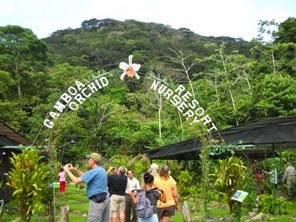
      On arrival at our rainforest hotel in Gamboa we immediately spotted a group of capybara lounging under a small grove of trees. They are the largest rodent in the world, followed by the beaver, porcupine, and mara (animal resembling a hare). Its closest relatives are agouti, chinchillas, coypu, and guinea pigs. It inhabits savannas and dense forests and lives near water. A highly social species they can be found in groups as large as 100 individuals, but usually live in groups of 10–20 animals. The capybara for its meat and hide and also for grease from its thick fatty skin which is used in the pharmaceutical trade.
     We motored around Lake Gatun visiting several small islands to watch for animals, and it didn’t take long for the capuchin monkeys to find us. Before long they were jumping onto the boats, running along the canopy, and back into the trees. They were very playful. We rode around stopping at several small islands.
    We also saw a small iguana, a good size crocodile, blue heron, some kind of a duck, and a couple squirrel monkeys. They enjoyed throwing a small yellow fruit about the size of an apricot at us.
     What a fun afternoon!
           

Sunday, September 21, 2014

CHAMONIX, FRANCE

                            Famous for its Mountain
      Established in the11th century by Benedictine monks, Chamonix is situated in the north-westerly part of the Alps, just 15 km from the Swiss border via the Col des Montets and 15 km from Italy via the Mont-Blanc tunnel. The natural border, where these three countries converge, lies at 4138-feet on the summit Mont Dolent.
French Alps
      Chamonix, with a population of 10,000, and its valley are dominated by the Mont Blanc chain to the south and the Aiguilles Rouges (red peaks) to the north.  The community of Chamonix-Mont-Blanc includes 16 villages and hamlets. One of the oldest ski resorts in France, during the winter season the population swells by an additional 80,000 people! The first winter Olympics were held in Chamonix in 1924, and now the area receives 5 million visitors a year.                                                     
      The Arve, the main river of the upper Savoy, starts at the Col de Balme and flows a 107 km through the Chamonix valley on down to Geneva where it joins the Rhône.      
      The glacial valley measures 17 km, from the northern most point at Col des Montets to the Taconnaz torrent. The town center is at an altitude of 1121-feet; the highest village at the top of the valley is Le Tour at 1585-feet.
       It was a 2-hour drive from Cogne, Italy to Chamonix. We stopped in Courmayeur, Italy for a gelato break before entering the 11-mile long tunnel connecting the city to Chamonix (3500’). Because of previous fatal accidents now all vehicles are checked for temperature before entering the tunnel. There is an escape route about every kilometer throughout the tunnel. The toll tunnel saves drivers 160 km if one had to drive around. 
Top of Mont Blanc
       On arrival it was unusually clear and sunny so we all agreed we’d visit Mont Blanc immediately after lunch rather than taking weather chances the next couple of days. It was an excellent choice. The weather was not bad the next couple of days but was intermittently more cloudy.     
      Mont Blanc, the highest European mountain west of Russia, holds a special allure for climbers. Chamonix is famous for its spectacular cable car up to the Aiguille du Midi (12,605’). Constructed in 1955, it was then the highest cable car in the world.
Receding glacier from hotel balcony
      The growth of tourism in the early 19th century led to the formation in 1821 of the Compagnie des Guides de Chamonix to regulate access to the mountain slopes. This association held a monopoly of guiding from the town until it was broken by the French government in 1892; thereafter guides were required to hold a diploma issued by a commission dominated by civil servants and members of the French Alpine Club rather than just being local residents.        
      Two famous statues are in the centre of Chamonix. One commemorates Horace Bendicte de Saussure who, in 1760, offered a substantial cash prize to the first person to reach the summit of Mont Blanc, but the prize was not  claimed until 26 years later by Jaques Balmat. The other statue is of Dr Gabriel Michel Paccard, Jacques Balmat's partner on that historic ascent. 
       In winter months the area gets only 3-4 hours of sunshine a day. The glacier which we saw so well from our room balcony originally reached the city.  It has receded over 2 K in the past ten years. Of the original 107 glaciers in Europe, 93 remain and in 60 years it is predicted that only two will remain! A scary thought indeed!

Wednesday, September 17, 2014

MEMORABLE BIRTHDAY LUNCHEONS


                    Broughton Castle

      I visited several castles, a couple really memorable ones, before I ever had lunch in one. I’ve also eaten in a several castles since that first one but two are memorable birthday lunches.
      It was after a hoof and mouth disease outbreak that I found myself in England on my birthday. Because we were a small group of 6-7—as many others had canceled the trip—we had a lot of latitude regarding time and venues. It was a complete surprise that we would be at Broughton Castle on that special day.
     A wide 6-foot deep moat surrounded the stately 1300s castle. (Many castle moats have been filled in and grassed over.) We arrived late morning—just in time for lunch. We were served a typical ploughman’s’ lunch, which was a first for me. Traditionally such a lunch consisted of cheese and hard bread. The drink was most probably ale. The ploughmen would take their lunch to the fields, just like the miners took theirs into the mine. Today restaurants add a small green salad and sliced tomato to such a lunch and in parts of England it is a popular lunch item. Tea and cake followed our lunch.
      The large castle has oversized rooms and I particularly remember 6-foot long logs ready for the immense fireplace. Many movies have been filmed at the castle, especially in its lovely interior rooms. The gardens here are large manicured Victorian ones.

                  Caffe Nazionale 

      Fast forward 12 years, after more castles, palaces and lunches, when at 81 I found myself hiking the Alps in Italy. We spent the morning touring the massive Roman ruins in Aosta, Italy. The local docent finished the two and half hour tour at lunch time.
      With a little research beforehand I figured we’d be in Aosta (the a is silent  and the o long) on my birthday. I read about the Caffe Nazionale having been in service since 1886. It was a long ago private sanctuary with a chapel for the Dukes of Savoy. We had no problem finding the Caffe inside the Roman gate and located on the large main square.
     We passed on the sidewalk café and opted to eat in the 10-vaulted chapel, each with a lovely fresco. English is a bit scarce in this part of the world, but our pleasant waiter spoke enough to answer our questions, help with the menu and make some conversation. My daughter and I each ordered a salad; hers was a side salad, but remembering how salads often come in Europe I ordered a mixed salad. My eyes got big when I saw the size of my salad that could have been a whole meal in itself! I managed to eat half of it. My daughter ordered roast beef which was thinly sliced, cold and spread on the plate under frilly greens and thin slices of cheese. Potatoes were served on the side. I’m not big on cold beef, so I ordered lasagna which was excellent, and again the serving was large. By the time we finished our meal, neither of us had any room for dessert. The service was good, the food excellent to say nothing of the ambience. What a treat!
     We could have lollygagged over coffee, but the restaurant was busy and we wanted the waiter to be able to turn our table plus we still had lots more to see.
     That evening the lights dimmed after dinner at our Cogne, Italy hotel and in came the waitress with a lovely birthday cake while everyone sang Happy Birthday.  It truly had been a great day for a little old lady who doesn’t know enough to stay home in her rocking chair and watch the grass grow!


Sunday, September 14, 2014

NORWAY


Lovely Country

       At the Hanseatic Museum we picked up a guided tour in English. Our timing was perfect! The museum is situated in one of the old trade houses at Bergen. The museum has old interiors from the 18th and 19th centuries.  In 1360 German merchants set up import/export offices in Bergen and dominated the trade for 400 years.
       The Hanseatic merchants traded mainly stock fish from Northern Norway and grain from Baltic countries. Only German merchants were allowed to live at Bergen during the period of the Hanseatic Office.  Hanseatics were unmarried and had to live in celibacy as long as they lived in the area. The tenements in the Bergen area each consisted of several smaller trade houses, each run by a merchant with a journeyman and apprentices. Neither light nor heating was allowed in the tenements because of the danger for fire. Behind each tenement there was an assembly hall, called schotstue, belonging to all the merchants of one or more tenements. The assembly halls could be heated, and in connection with these halls there were also a kitchen as well as storage room for food.
       A fire in 1702 reduced the city to ashes, but it was quickly rebuilt on the foundations that had been in place since the 11th century. The museum is one of the best preserved buildings in the city and is furnished in the style of the 1700s.
      Hanseatic apprentices were teenage boys. They slept two to a bunk, head to toe, in narrow single beds in enclosed cabinets. They actually were locked in at night so there was no monkey business.  Punishment was severe for infractions of the rules. No smoking was allowed because of the real danger of fire.
     The League was created to protect economic interests and diplomatic privileges in cities and countries along the trade routes the merchants visited. The Hanseatic cities had their own legal system and furnished their own armies for mutual protection and aid. Despite this, the organization was not a city-state, nor can it be called a confederation of city-states; only a very small number of the cities within the league enjoyed autonomy.
     It was an interesting visit on a drizzly day and enlightened me to a society I had no idea ever existed.
           
    If you ask people what they associate with Norwegian history and culture, their answers will vary. Some will say the Vikings sailed to foreign parts to pillage and wage war, although the Vikings were in fact also merchants who founded kingdoms on foreign soil and brought back new impulses to Scandinavia. Others will point to internationally famous authors, composers, actors and painters. Others may mention attractions like Vigeland's sculpture park, Holmenkollen and the stave churches or the expeditions of Thor Heyerdahl, Fridtjof Nansen and Roald Amundsen. Maybe someone will mention smoked salmon, lutefish, reindeer meat, shrimps or cloudberries.  
    One thing is certain, Norway is more than untouched nature. The country, rich in history, is poor in large historic monuments. Nature has formed the Norwegian character and given it a kind of durability that has formed the Norwegian national identity. Thanks to the country's rich natural resources, Norway has long been an industrial nation. There is special pride in being one of the first countries to eradicate illiteracy!          

   My take away of  Norway include  its many smokers, restaurants not service oriented, AMs are misty but clear by mid morning, expensive, many fountains in parks, few hi-rise buildings, chestnut trees,  narrow streets, public restrooms frequent, clean and free, and courteous drivers   giving pedestrians a break!
    And the scenery is spectacular!