Wednesday, October 22, 2014

MONET AND GIVERNY

                         Monet's Home and Garden
                          
      I was excited to learn we were going to make an unscheduled stop—to Monet’s home and gardens! The highlight of this trip was Normandy so it was a real bonus.
      Claude Monet noticed the village of Giverny while looking out of a train window. He made up his mind to move there and rented a house and the area surrounding it. In 1890 he had enough money to buy the house and land outright and set out to create the magnificent gardens he wanted to paint. Monet lived in Giverny from 1883 until his death in 1926. He and many members of his family are interred in the village cemetery.  
      Following restoration, Monet's house and gardens were opened to the public in 1980.We wandered around the lily ponds first and over the stream bridges. The beautiful gardens were so quiet and peaceful. Still
Monet's home
in bloom the gardens were a profusion of color. Sunflowers were 7-8 feet tall with blossoms the size of dinner plates. I was able to identify many of the flowers but there were also many that I could not. I look a lot of pictures and my very favorite, which is now my screen saver, is a gorgeous pink and white peony, the bloom of which rivaled the size of the sunflowers!
      Monet initially painted the countryside, but after buying the house, he began transforming the gardens. He used different heights to create volume. Fruit trees or ornamental trees dominate the climbing roses, the long-stemmed hollyhocks and the colored banks of annuals. Monet mixed the simplest flowers, daisies and poppies, with the rare varieties.
Part of his water garden
      The Japanese inspired water garden and the surrounding vegetation form an enclosure separated from the surrounding countryside He had a water-garden constructed, even diverting the local river to achieve his vision.. The famous Japanese bridge was built by a local artisan. The pond was inspiration for his famous water lily paintings. He also painted a lot of weeping willows as a memorial to those lost in WW I. 
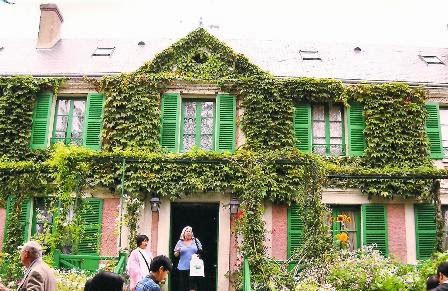
      We spent a lot of time on the gardens, and eventually moved into the house. The original house was much smaller than it is today. Monet enlarged it on both sides. Monet loved color and chose all the colors in the home. The house is pink with green shutters—a marked deviation of the normal grey shutters of Victorian times. The barn next to the house became his first studio, thanks to the addition of a wooden floor and of stairs leading to the main house. Monet, who mostly painted in the open air, needed a place to finish and his store canvases.
      Monet added a gallery in front of the house; a pergola covered with climbing roses, and grew a Virginia creeper on the façade---he wanted the house to blend with the garden. 
      Blue is used extensively throughout the home. The dining room though is painted a vibrant yellow with blue tiles to coordinate with the blue kitchen when the door was open. Walls showcased Japanese engravings that Monet chose with an expert eye. For fifty years, he collected the prints by the best Japanese artists.
      Monet was one of few who became famous during his lifetime, although he had to wait until he was fifty before he was recognized as a master.
      It was a thrilling visit that definitely put Giverny  on my revisit list!


Sunday, October 19, 2014

St ANDREWS, CANADA


                       St Andrews and its Historic Sites

       Loyalists established the historic fishing village of St. Andrews in 1783. The small seaside village has a present population of about 3000. When the King’s surveyor laid out the town he plotted 60 even square blocks. King Street runs from the wharf up the center of town to the top of the hill. It’s the steepest hill to walk, although not strenuous. By following the waterfront south 4-5 blocks before turning east the hill almost disappears and you can walk tree-lined streets of well kept old homes with manicured yards.   Many of the homes in town came by barge from Castine, Maine years ago when loyalists fled to Canada.  
      The court house and jail date to 1840 and the Greenoch Presbyterian Church to 1824. At the St. Andrews Block House Historic Site, north of the town center, we learned the block house by the bay was a fortification of the war of 1812. Made of square logs, instead of round ones, eliminated air spaces and allowed lesser penetration in case of attack---which never occurred. The blockhouse was close to an island just off shore in the mouth of the St. Croix River and is where in 1605 seventy Frenchmen made the first settlement.
       A strange shaped block of wood we learned were muzzle plugs. Kept in the muzzle mounts when the mounts were not in use, they kept out the cold in the winter.           
      We drove to the point where at low tide one can drive across flat stone to Minister’s Island, settled in 1790 by an Anglican minister from Connecticut. The 500-acre island originally had 22 buildings of which eleven remain. The island was self-sustaining. In 1890 a Mr. Van Horne, founder of the Canadian railroad, bought Minister’s Island.  In 1977 the island with its three-story barn, the largest in Canada, and the 50-room summer cottage became the property of the provincial government. No humans live on the island but 60-70 deer do.
               
       Our first stop walking the darling little city was the Andrew Sheriff House on King Street where we had a delightful visit and a good time talking to the friendly docent.
      The house, built in 1820, is one of the over 100 historic buildings in St. Andrews. Right away I spotted and pointed out to my buddy the Christian door.
       The kitchen, located in the basement, had a brick floor laid over a thick layer of sand to promote quick drainage in case of flooding. The accordion lathe work ceiling positively fascinated me. It had been left unplastered, and was so much prettier than a plastered ceiling. However, it probably was not as insulating. A large table in the kitchen also made into a chair when the top was tilted back---a large chair, one for cuddling children.
       As we returned upstairs the docent said, “Only three families have lived in this house. In 1986 the Bond family bought the house, restored it, and gave it to the province. The home now is a working museum teaching children the art of cooking in a fireplace, making soap and candles (the old fashion way, not with wax) as well as other Colonial endeavors. If one did not make his own candles, it could cost him a third of his pay to buy them, as candles were very expensive items in Colonial days.”
      It took two men six months to cut enough wood to feed the home’s nine fireplaces in winter.
      We had a lot of fun talking to the docent who was a world of information and spent a fair amount of time in this wonderful old house.


All Saints Church,
        The church was built in 1867. Pictures and narrative in the foyer revealed that Diana and Prince Charles visited the church in 1983.
This church replaced one built by Loyalists in 1788. Samuel Andrews, from Connecticut and of Minister’s Island, was the first pastor. He was seven years old when he arrived in St. Andrews. The sheriff had extensive responsibilities as he covered all of Charlotte County, not just the town. If he was unfortunate enough to lose a prisoner, he was fined.
The Anglican Church’s ceiling is built from pews of the old church and resembles a ship’s hull turned upside down.  The lovely stain glass windows were made in England. The pulpit is from the original church. The Royal Coat of Arms of William and Mary is above the arched doorway. It was brought from the Connecticut church by the first pastor and is believed to be one of only six that survived the American Revolution.
The docent here was very friendly and knowledgeable. She too was fun to converse with.

Ross House Museum
      The docent here told us, “An American lawyer by the name of Harris originally built this house in 1822-24, then he and his family of 11 children moved into the home. In later years Harris left the town money to build a library and add a wing to the hospital. After Harris the home was vacant for several years.
      In 1938 Mr. and Mrs. Ross, a childless couple, bought the house, when in their 60s, simply to display art and furniture collected as they traveled around the world.    Mr.Ross, an Episcopal minister from Taunton, Mass., was born in the late 1860s. In the early 1900s he visited a friend in St. Andrews who took him on a buggy ride. Ross fell in love with the area and bought a home at the bottom of the hill he named Rossmont. The couple returned to Rossmont every summer until 1945. Mrs. Ross’s father was president of Dunn & Bradstreet, and upon his death left his daughter a wealthy woman.
      We wandered through the museum marveling at the lovely furnishings and art.  
       It had been a delightful day. We saw lots and had great fun talking to all the friendly docents.     When all was said and done we returned to our lovely hotel.


Wednesday, October 15, 2014

COSTA RICAN VOLCANOES

                                                  VOLCANOS

                                                  
         In Costa Rica, we were told that less than 10% of the tourists see Arenal clearly as its cone top is most often shrouded by clouds.  I could not believe how lucky I was on both trips to see it clearly nearly all the time we were in the area. The first time hurried off the van for pictures not knowing how long the clouds would stay at bay—then come to think about it there was hardly a cloud in the sky. Our motel room was directly across from the volcano. I could lie in bed and watch the red glow of the falling lava all night. My photographer son elected to stay up on the patio for his photo ops.
        It remained clear all night, and the volcano just kept belching its smoke and lava steadily all night long
Arenal exploded to life in 1968, after 400 years of inactivity, and has been steaming and spitting ever since. During that massive eruption 80 people were killed. Arenal is  perfect conical volcano, but as years pass the cone will eventually fall in on itself. It is one of the world’s most active volcanoes.
        A dam built in 1978 created a 25-mile long lake. The road around it really requires a four-wheel drive vehicle. There are several resorts around the lake as it is a popular recreation area.
         On another trip we stayed in a new 5-star hotel in La Fortuna, a farming community of 5000. We were literally at the foot of the volcano and again after a rainy day before, we had clear weather and wonderful visibility. I was delighted as I was anxious to show my granddaughters Arenal. They were amazed.
     On that visit with the teenagers we also visited Poas Volcano.  At an altitude of 8659 feet it was established as a National Park in 1971.  It has been dormant since 1991. The crater, over a mile across, is the second largest in the world and covers 13,138 acres.   Geysers in the crater occasionally go off, and we were lucky to see one small one. Poas has erupted 20 times since 1834. In 1974 she spewed volcanic ash 30,000 feet into the air. In 1989 volcanic activity closed the park most of the year. Surrounded by cloud forest, it is humid, damp and most often misty. We got whiffs of sulfa fumes.  We walked the half-mile paved path to the volcano to find it totally socked in with a heavy mist. It was a delightful walk with rich growth everywhere.  Rhubarb-type leaves were common and were the largest leaves I’ve ever seen. They were absolutely huge.
       A Cloud Forest is created when warm air from the ocean is forced upward by mountain slopes. As the moist air rises it cools forming clouds. The Poas crater is seen 30% of the time, and the best chance of seeing it is in the morning. We were there early, but still had the heavy mist in the beginning. Cloud Forests are eerie and majestic in early morning light.