Sunday, October 12, 2014

ALL ABOUT PEAT

                                                 PEAT OR TURF

       Peat has always been an important ingredient in Irish life as they used it both for fuel and cooking. When Ireland became a republic, the government gave every Irish family one acre of peat land. It is also often referred to as turf. This acre is inherited by offspring. The acre may or may not be near your home. For decades each family would gather with his neighbors and friends in July after a few dry days to harvest the peat.
      It was a hard and long chore. A special narrow spade is used to cut out a block about a foot long and 6 inches wide and thick. The logs, 90% water, are stacked teepee style to dry. After a few days all the logs need  to be turned. When completely dry they are quite light and are taken to the home and thrown on a pile for burning. I forget what that pile is called.
      Today, large machines with big wheels set wide apart are used to harvest the peat and can accomplish in a half day what took days to do by hand. Everyone helped everyone else in this chore. Burning peat gives off a strange aroma which I liken to incense burning.
      Electricity did not arrive in many areas of Ireland until 1958---and running water not until the 70s. Now many homes use electric heat.
      Seventeen percent of Ireland is bog land. Each foot of peat dug represents 1000 years. Blanket bog runs 10-20 feet deep but raised bog runs up to 30 feet deep. Bog land is very spongy and soft. Often old preserved oak will be found when digging peat. Buried air tight, it is well preserved and I liken it to drift wood. It is often used in decoration. It is not uncommon to find a body and when they do it is well preserved. The hair turns red, but the skin remains soft. It is possible to know what the person ate for their last meal as the contents will still be in the stomach! Sometimes the bodies are very old.
      Small, sure-footed, versatile ponies now known as Kerry Bog Ponies reflect the qualities of their living and working environment. They were used on family holdings in the mountains and valleys of Kerry for centuries. They were known locally as Hobbies. They were used to transport peat when it was dry from the bog to the home. They are cute little fellows and we saw a couple alongside the road one day posed waiting for picture taking.
      We stopped at a bog one day and it was really quite easy to jump up and down and feel the earth move. It was a strange sensation! The ground was very spongy, not quite as spongy as a water bed but definitely spongy. We smelled burning peat several times while riding around the countryside in a van over narrow country roads. I never really knew anything about peat and found it quite fascinating.


Wednesday, October 8, 2014

HONG KONG

                                          City Information


Hong Kong means frequent harbor. Also called The Gateway to China, Hong Kong is home to 8 million people. The World’s Playground covers only 400 square miles. China’s Jewel is actually a group of 235 islands in the South China Sea. The City of Life has more billionaires and Roll Royces per capita than any other city in the world. No matter what one calls the city he is talking about Hong Kong, which a hundred years ago was a sleepy fishing village.
Hong Kong is made up of three sections, Hong Kong Island, Kowloon, and the New Territories. Hong Kong Island covers 31 square miles and has a population of 1.8 million, Kowloon covers 18 square miles with a population of 2.1 million, and the New Territory’s 235 islands cover 374 square miles with a population of 3.4 million people.
Kowloon is a 40-minute drive from the airport. Cantonese is spoken in Hong Kong and the word for hello is lay ho and  doe chay means thank you. Hong Kong  has its own currency and on my last visit one US dollar equaled 7.75 Hong Kong dollars. Driving is done English style  on the left side of the road, so be aware and careful crossing the street as  pedestrians do not have the right of way. I noted that traffic moved very fast but it stops immediately, no matter where they are, when a traffic light changes. It was amazing to see this. Obviously brakes are very good as are reflexes! Ice and water in restaurants is ok to drink, but drink bottled water otherwise.
Today the Wall Street of Asia is a hard paced, materialistic society. It is a city of marked contrasts where modern skyscrapers and cell phones mix with Chinese junks and ancient medicine. Although England turned its colony over to China in 1997, a British influence remains. After all, England ruled the colony for nearly 100 years. High tea is still popular in the city.
Because of limited real estate space rents are extremely high and the cost of living is one of the world’s highest. Another contrast, awesome to think about, was the bamboo scaffolding along the sides of the new hi-rises being built. Sensational modern architecture often cling to 45-degree slopes.
Although today Hong Kong is a cosmopolitan city, it continues to be steeped in Chinese traditions, spiritual beliefs, rituals, superstitions and the ancient art of Feng Shui. This combination creates a rich cultural tapestry of life.  Feng Shui is the art of positioning objects in harmony with nature to create good fortune. Even today architects consult Feng Shui masters in regard to construction. In Chinese mythology dragons live in mountains, and Hong Kong is built on mountains. Openings and glass doors are common sights in buildings so that dragons can pass through them from the mountains to the harbor for a drink. Hong Kong is certainly a city of contrasts of old and new, east and west and ancient traditions blended with a gleaming modern city.
Streets were teaming with people---all the time. The city is a shoppers’ paradise. In fact many people visit the city for the express purpose of shopping. A tailor-made suit can be ready in 24 hours at about one-quarter the cost if made in the United States. The city’s tailors are some of the best in the world. Hong Kong has no exports, but they repackage a multitude of products. It is said that one can buy anything in the shops lining the lanes leading off the main streets.
            We arrived in Hong Kong the last day of the week-long Chinese holiday and the streets were one big mob scene. Since all the hotels that used to be on Hong Kong Island have been moved to Kowloon, that is where we stayed. The area is half the size with twice as many people, but there was little we could do about it. Kowloon means nine dragons and is named for the hills behind the city. Victoria Peak on Hong Kong Island is locally known as the back of a dragon and provides a magnificent view of the city and harbor.
            City cabs were red with a gray roof and all looked new. They were everywhere, so finding one is no problem. The best views of the city are from the water or from the mountains. One high-rise after another sprawl up the mountainsides.
            There are five tunnels under the harbor. The first one, opened in 1972, is a mile and quarter long and  65 feet below the water level. It can accommodate 110,000 vehicles an hour, but the average is only 79,000. The second tunnel opened in 1979, and the last one, a train tunnel, in 1998. It was good to learn that taxis charge round-trip when using the tunnel, because they have to get back to where they started.
                Reflections in glass building fronts were seen everywhere. The 5th tallest building in the world with 88 stories is on Hong Kong Island. Another building known as the Swiss cheese building has 1728 round windows. It is difficult to find a building that is not a high rise, and when you do it is dwarfed by the high buildings around it.
                The city has few historical sites and only a handful of cultural sites. But one of them is Man Mo Temple, Hong Kong’s oldest temple that is now dwarfed by surrounding buildings. Built in 1847, the temple honors the gods of literature, man, and war, Mo. The strong pungent scent of burning incense was noticed immediately upon approaching the temple. Inside the front door hung huge bell shaped incense coils. The air was very smoky and hazy inside. To the left of the entrance sit the ten judges of the underworld. Fabric banners are displayed all over the walls. Buddhist and Taoist statues are inside.
            People come to the temple to ask for guidance as well as to give thanks afterward. Profits from the organization that own/manage eleven temples support schools. The prayer bell was cast in Canton in 1847. Along with a drum it is a call to the gods for their attention that an offering has been made.
            For the shopper the city is a paradise with everything from street hawkers to high-end upscale department stores, with everything in between. You can buy anything here. In Hong Kong they believe that the body is a delicate balance of the forces known as yin, (water, quiet, substance and night) and yang (fire, noise, function and day). It is said that the balance of these forces is what makes Hong Kong unique.
             I’ve been in several cities where there are steps up hills or even short gondolas, but the mid-level escalator on Hong Kong Island was a new feature for me. We were told it cost 30 million dollars and takes twenty minutes to ride the two-mile-long escalator from one end to the other. Elevation goes from street level up to 185 feet. The escalator runs only one way and changes directions to accommodate rush hour traffic. There are 29 exits/entrances; one about every block. The escalator is well utilized and relieves a lot of street traffic and pollution in the city.
            In a post dated 5-25-14  I noted the changes that have taken place at Victoria Peak in the years between my visits to Hong Kong when our hotel was actually on HK Island.


Sunday, October 5, 2014

THE GUINNESS EXPERIENCE

                        A Fascinating Museum and a Surprise at the top


       I am a wine drinker and not a beer drinker, but that doesn’t mean I haven’t visited a lot breweries and distilleries in my travels.
      The #1 attraction in Dublin, Ireland is the Guinness Brewery built on 60 acres in 1759. That year Guinness inherited $150 and decided to acquire what was then a small, unused and ill-equipped brewery at St James's Gate. The lease, signed on 31 December 1759, was for 9000 years at an annual rent of £45.
      Arthur Guinness was born in 1725 near Dublin in the town of Celbridge, County Kildare where his father, Richard Guinness, was a Land Steward. Part of Richard's duties included supervising the brewing of beer for the workers on the estate, and it is probable that young Arthur learned the art of brewing from his father. The brewing industry in Dublin at that time was suffering because English beer was taxed less severely than the home-produced product.
       At first Arthur brewed ale, but by the 1770s a new strong black beer called porter was being exported from London.  Arthur took a chance on brewing this new product and the rest as they say is history. Just FYI, Stout contains more hops than either lager or ale. It takes 119 seconds for Guinness to settle. A pint is shy of 200 calories and contains 4.3% alcohol.
       The Guinness Storehouse is a 1904 cast iron and brick warehouse that now serves as a museum. We were able to get in on the senior rate everywhere in Dublin that had an admission. At Guinness the senior rate was 9.50 Euro compared to 14 Euro.
      The museum’s six floors circle an atrium. There were a lot of people, but the museum in the Storehouse is well spread out and with everyone moving at their own pace it worked just fine. The displays included multi-media and lots of old equipment. It was most interesting as we moved slowly up four stories. At that point we could take an elevator up the next couple of floors to the Gravity Bar. But a crowd was waiting for the elevator so we opted to continue walking. The Gravity Bar at the top offers a spectacular view of the city.
       It was a beautiful clear sunny day and the 360 degree view of the city was awesome. After rotating around the room soaking in the scenery we found a couple of empty seats just as people were vacating them. I went to the bar to get my friend her pint and asked for a half pint for myself. I drank about half of it. It was not as strong as I anticipated. Eventually it got pretty warm sitting in front of the sunny window, so we took the elevator back to ground level to continue sightseeing.
      This exhibit is unique in its layout and is very well done. It’s certainly worth one’s time to visit when in Dublin, regardless of one’s preferred drink.

Wednesday, October 1, 2014

FUN EVENTS DOWN UNDER

                                        Some of Many Surprises
Punt Ride
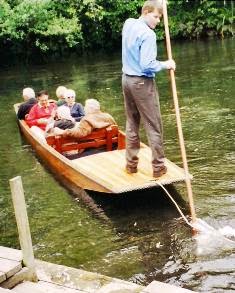
      My first and only punt ride was on the River Avon in Christchurch, New Zealand. A punt is a flat-bottomed long boat, square on both ends, and wide enough to seat two abreast that is propelled with a long pole. Standing on a platform on the stern of the punt, the pole is placed on the side and pushed from the bottom. Punts are used on shallow rivers and originally were made to transport cargo. Punting is quite a sport in certain parts of the world. Most often a punt can carry six passengers. We leisurely floated down the river admiring the many mansions and beautiful gardens along the way.
It was a new and fun experience.

A Dining Tram   
      I’ve had meals in the dining car of trains but had never had a meal on a tram until I was in New Zealand the second time. We boarded the tram at dinnertime to find the tables set with white linen. As we circled the city several times, tux clad waiters served a delicious lamb meal with all the trimmings, including wine. It was great fun. I’ve heard about similar experiences in a few other cities so if you ever are where one exists it will provide a unique dining experience and  fun time.

Orphaned Kangaroo
      We were surprised when we walked into a store on Kangaroo Island, Australia to see a baby kangaroo swaddled in a sling hanging on a coat rack. The owner told us that Mama had been killed by a car, so they’d been raising the little one. She was wrapped in the sack because it confined her like she was in her mama’s pouch.  We all took turns holding and loving the baby while cameras clicked away.

A Flightless Airline?
      We arrived at Kangaroo Island from Adelaide by ferry over a rather rough channel. But we returned on Emu Airlines---remember the emu does not fly, so why would anyone name an airline after the animal? We didn’t think too much about being weighed with our packs, but it was a little disconcerting to watch the pilot load out packs in the wing and then climb up on it and crawl through a window to his seat! It was a short flight, but I was happy to be on the ground and off the small 6-8 seat plane.

Koalas in the Wild
      While travelling around the island we spotted many koalas up in trees, and  a couple of moms even were carrying a baby in her pouch. It is a bit unusual to see the nocturnal animals during the day. Daytime is when they usually curl up in the fork of tree branches and sleep. We stopped to admire several doing just that when suddenly a baby started crawling down from a tree.  When on the ground the baby walked several feet to where a gal was standing and started to climb up her leg!   
      Her pants were almost the exact color of the tree trunks, and she figured the little koala thought her white shoes were rocks. The driver wiggled him off her leg, but not before he left a puncture wound in her lower leg. What an adventure!

      Lots of fun times down under!

Sunday, September 28, 2014

AIX EN PROVENCE

                                         A Charming French City

Aix-en-Provence, France is a city of fountains and tree-lined avenues, as well as the home of Paul Cezanne. On a walking tour it was hard to miss the sites from the famous painter.  Markets and monuments also highlight this ancient city. The city is often referred to simply as Aix (X). A town of water and town of art...Aix was built and developed around this dual identity. But the town also knows how to blend different eras and cultures. It is a city of human dimension where the preserved heritage and the city of tomorrow blend perfectly.  Color is sensation: the light of the sky, the golden stone of the facades, the transparent green of the fountains, and the shade of the plane trees all blend to create a wonderful atmosphere.     
In Greek, platanos  means big, a characteristic that the plane tree develops easily in favorable conditions. Plane trees, living up to 2000 years, is considered symbol of wisdom, stability, safety and strength. The main peculiarity of plane tree is a wide range of shades even within one log: from pink-grey to red-brown or even yellow. Fragrance of plane wood is used in the production of toilet water for its fragrance. The city was full of plane trees lining many of the streets.
Water, the source of life, is at the heart of the town and its history, Water has been channeled and distributed since antiquity. In a region where water is scarce and precious, Aix has been supplied by its many springs. But in the second half of the 19th century, works on the Verdon Canal and the Zola dam brought water in abundance through the basins of fountains.
From the start, from a simple basin, well or watering place, fountains found their illustrious history during the 17th century as ornaments of the urban landscape. Construction was restricted to specialists, fountain architects, hydraulics engineers and artists. Today about forty public fountains testify to the styles and needs of a town which has integrated them in its art of living. Aix means water and is the symbol of the city.
            In Provence house doors face the north and windows face away from the Mediterranean. The winds are frequent and can be very strong.
            The1860 La Rotunda fountain is very large.  A local guide explained that the three statues: justice, agriculture and fine arts adorning the fountain recall the main activities of the town. The fountain was a symbolic mark of the entry to the modern town, without rampart or gate, open to the world. Aix has grown and today the great fountain is at the centre of the town. The square, actually a large round-about, is the entrance to the once Roman city. It was never an important Roman city, but one can see ruins in several places. Provence is the oldest Roman city in France.
            Balconies on the buildings could not be added until after welding was invented, then a balcony was a sign of power and wealth. We saw a couple of buildings with columns and learned that they were considered power of the gods and were not allowed on the outside of a building so the ones we saw were added much later. Many of the buildings were made of yellow limestone and looking carefully we often could see fossils in the facades. The red and gold flag goes back to the 12th century and came from Spain.  Provence joined France the end of the 15th century.  The old wall and ramparts came down in the 19th century and the ring road was built over it.
            After the revolution the city felt like sleeping beauty, but was revived in the 19th century when the ancient wall came down. Until 1953 one could not move from the north to the south of the city without paying a fee through the tower at the market.
St. Sauveurs cathedral is built over the old Roman forum and showcases architectural styles from the 12-18th centuries. The church and tower were finished by the 19th century, but only up to the gargoyles, prior to that the style was neo-gothic. The bases of the marble columns are from the Roman forum. The pews in the front part of the church were quite different. Four distinct chairs were joined together with a single curved back board. The back of the chair was about shoulder high. The chairs then were lined up across the church; after several rows the pews turned into the benches we know today. The old cloister is now a lovely garden dedicated to Christ.      


Aix is a fascinating city with a lot of history and we had a wonderful time exploring it, enjoying the fountains and eating some wonderful French cuisine.