Wednesday, March 11, 2015

NASSAU, BAHAMAS SITES

                                        Popular Nassau Sites
    Fort Fincastle. Lord Dunmore established the fort in 1793 on Bennett’s Hill as a lookout for pirates and invaders. The fort shaped like a paddle wheel was never used because Nassau was never attacked. Three cannon are still in place, although are not original. Later the fort was used as a lighthouse and then as a signal tower.
       The views from the fort are spectacular. There also is a 128-foot high round concrete water tower in the area.

   St Andrew Kirk Dated from 1810 the church has been through many changes over the years. In 1864 it was enlarged and a bell tower added. The Ref community considerably increased by the end of the 18th century when the British colonists who had remained loyal to the British crown in the revolutionary war in the United States were forced to leave. Also a substantial number of Scottish Presbyterians settled in the Bahamas in 1783. In 1798 they formed the St. Andrew’s Society, and in 1810 the foundation stone of St. Andrew’s church was laid.

    Christ Church This stone Cathedral in simple Gothic-style with a square tower was started in 1837 and was consecrated in 1845. It replaces four earlier churches stretching back to about 1670. The interior has a fine set of stained glass windows (1868) an impressive organ and a mahogany ceiling. The first church was destroyed by the Spaniards, the second built in 1695 was destroyed by the French and Spanish invasion of 1703. The third church was made of wood and the fourth and present stone church dates to 1753-54. A steeple was added in 1774 but removed in 1827
   Of particular interest are the memorial plaques from the 1800s documenting the life histories of local residents and their deaths in shipwrecks, of yellow fever and after childbirth.
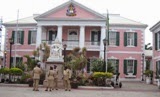
  
 Government House Erected in 1801 the original building was badly damaged in a 1929 hurricane and had to be demolished.  The present building was finished in 1932. The statue of Columbus was imported in 1830. The interior was decorated by the Duke and Duchess of Windsor in 1940.

  Statue at The British Colonial Hilton was built on the site of Old Fort Nassau (1695), once the home of the notorious pirate, Blackbeard. After the British Crown drove Blackbeard out, Woodes Rogers, was appointed Governor. Now, his life-like, swashbuckling image with sword drawn and cloak swirling around him stands at the front of the hotel as a vivid reminder of Nassau's turbulent past.
    Captain Woodes Rogers was appointed Royal Governor of the Bahamas in 1717. Before becoming Governor, Rogers was a privateer from England sent on expeditions in order to harass Spanish colonies throughout the Atlantic coast. From his successful expeditions he brought many valuables back to England. Soon, his focus remained on suppressing pirates from the Caribbean.
   With all monetary and military resources from England at his disposal, Captain Woodes Rogers also had a powerful ally: the king’s pardon. Pirates were fully pardoned if they would agree to cease pirate activity immediately. In the end, those who chose amnesty would later join Rogers in confronting pirates slow to surrender that often would end with sentencing and hanging. Eventually, Rogers was able to establish a well-organized government and eventually expel all pirates from Nassau
   
 Once a private estate, the Graycliff Hotel is an elegantly renovated 260 year-old British Colonial style hotel that sits next door to Government House. The hotel has a history that dates back to the 1700, the year it was built by privateer John Howard Graysmith. Legend says it once served as the officers’ mess for the West Indian Garrison. Established in 1844 as Nassau’s first inn, the Graycliff Hotel has attracted many of the rich, famous and infamous alike; notably European royalty, government leaders such as Winston Churchill and the notorious Al Capone have all made appearances at Graycliff.
   In recent years a Canadian couple bought Graycliff and completely renovated the mansion and constructed the first swimming pool in the Bahamas surrounded with lush tropical gardens. The décor is a blend of old and new.
  The Graycliff Hotel is also home to the Graycliff Restaurant where the Graycliff Cellar has a collection of over 250,000 bottles of quality wines.
  
 The Nassau library was constructed as a Gaol in 1798-99. The three story octagonal shaped building held prisoner cells on the first two floors. On the third floor a bell hung that summoned House Assembly members to meetings.
  In 1879 the building became the Nassau Public Library and Museum.  The old prisoner cells now hold books, charts, artifacts and etchings.

   The Vendue House on Bay Street was erected about 1769 but only had a roof over rounded pillars. It was erected as a convenience for traders selling their goods.  This also included the sale of slaves, cattle and imported goods.  In 1913 the building was remodeled and a second story added.  Today it houses the Pompey Museum telling the story of slaves in the Bahamas.

You may also want to read: Queen’s Staircase 10-12-11, Adastra Gardens and zoo 12-21-11, dolphins  & ray swim 5-15-11  

Sunday, March 8, 2015

A BIT OF BAHAMIAN HISTORY


                              Nassau, A Popular Port 
      When I took my granddaughter to the Bahamas as a graduation present, it had been years since my first trip which concentrated on the out islands. Then only two and a half days had been spent in Nassau, so a little review of my diary refreshed my memory. The Bahamas is an archipelago of 700 islands and 2400 uninhabited cays and islets extending 720 miles. It is just fifty miles off the Florida coast. The capital is Nassau on New Providence Island.  The Arawak Indians were the first inhabitants and the first British settlement took place in the 17th century.
    No longer a sleepy little town that often characterizes its sister islands, Nassau stands out for its high-energy atmosphere and dynamic attitude. The capital city of the Bahamas with a bustling port, Nassau’s history can be traced back to days of the legendary pirate Blackbeard.
     Beautifully preserved cathedrals, pastel-colored Georgian buildings and 18th-century fortresses collide with bouncing jitneys, street vendors and duty-free shops and occasionally fine shops. Historic Bay Street is great for local markets, pubs and cafes, while the nearby straw market offers unique crafts and Potter’s Cay is the place for fresh produce, conch and fish.
   I was anxious to introduce her to a new culture and show her the city. We had a fabulous time and pretty much covered the entire island, often walking and walking. We enjoyed riding the local jitney to and from our distant  hotel.
     I was happy to find many positive improvements such as the lack of litter and friendly people instead of pesky and annoying people trying to sell you something or take you for a ride..

Music
Throughout the islands, music is woven deeply into the fabric of daily life. Musical traditions reflect both the impact of history on the islands and a homegrown, distinctively national character. Blues and spirituals made their way down from the American South and took on a Bahamian flavor---in breezy shore-side church choirs where "rhyming spirituals" are sung, and on homemade guitars in the hands of virtuoso performers.
Junkanoo, goombay and rake 'n' scrape all incorporate the handclapping and drum rhythms of West African dance music. Goombay is a secular Bahamian tradition, danceable music full of stories about love and other daily dramas.
Rake 'n' scrape bands are purely instrumental. A carpenter's saw, a goatskin drum and an accordion are all traditional rake 'n' scrape instruments.

True Bahamian
Bahamian English is a fascinating mixture of the Queen's diction, African influences and island lingo. Unfamiliar sounding words you'll hear on the streets and beaches may be survivors from the early English settlement (true Shakespearian English!), echoes of Africa or local slang. The "h" is often dropped in daily speech ('ouse for house or t'anks for thanks). Conversation is easy here – the distinctive sounds of daily speech are all part of a true Bahamian experience. At times it seemed as if I were listening to a foreign language.

Food
Fresh seafood lovers can appreciate the Bahamian fondness for conch (pronounced "konk") that is the most popular seafood in The Bahamas. The meat of conch is firm and white, and local restaurants have found delectable ways to serve it. Conch may be served uncooked with lime juice, steamed and added to other dishes such as soup or salads, or deep-fried, which is known as “cracked conch”. This seafood can be found in some form at just about every traditional restaurant in the Bahamas. Traditional desserts feature coconut. The Bahamas certainly do not have a shortage of coconut trees, and shredded coconut is found on just about everything!

Next time Nassau sites.

Wednesday, March 4, 2015

BELIZE

                 Get Away from the Main City
 
  Cruise ships have made people aware of Belize, but when I went there for the first time two decades ago people’s response was, “You’re going where?” 
When I responded, “Belize, the old British  Honduras,” then I'd get recognition.
    Belize is a small ruggedly beautiful country in Central America. The Caribbean surrounds it on the east.  Guatemala borders on the south and most of the west, and Mexico borders the northwest. Nearly one third of the country’s 200,000 inhabitants live in Belize City which is located on the northern third of the east coast.
   The country’s multi-racial diversity include: Creole of African descent; Mestizo are Spanish-Mayan; Caribs, also called Garifuna; with smaller groups of East Indian, Landino, and Spanish. Mayan Indians make up 8% of the population.
   Half of the country’s 9000 square miles is surrounded by water with numerous cays and three atolls dotting the coastline. The northern part of the country is flat rising gradually to a coastal plain running the length of the country. About one half of the mainland’s 8600 square miles (rest are atoll) is used for agriculture. To the south and west the terrain rises dramatically to 3000’ above sea level into the Mayan Mountains. This terrain is rugged with rivers running from the mountains through the plains onward to the sea. White water rapids and 1000’ waterfalls are interspersed in the rivers.
   Rain forest, Savannah, jungle, forest, and mangrove swamps all add to the land diversity. Seventy percent of the country is covered with forest. Much of the jungle is under government protection. Bladen Nature Reserve covers 92,000 acres in the Mayan Mountains. Cockscomb Basin Wildlife Sanctuary is 102,000 acres.
    To the East lies the second largest reef in the world and the largest barrier reef in the Western Hemisphere. The reef comprises 175 off shore cays and three atolls. Mexico has one atoll and together these four atolls are the only atolls in North America.
   The flora, fauna, and birds are as varied as the scenery. The only jaguar preserve in the world is in Belize.
The climate is sub-tropical with a high in summer of 95 with a winter low of 70s. The official language is English and all instruction in school is in English. Spanish, a strong second, is taught in the lower grades to further bilingualism. Creole is also widely spoken.
   The country’s tallest building is in the Mayan ruins at Caracol not in Belize City nor the capitol of Belmopan. The largest city, Belize City, like New Orleans, lies three feet below sea level.
In 1961 England made it clear that Belize could become independent at any time but fearful of being overrun by its neighbors Belize maintained British ties until 1963 when a new constitution provided self-government.     
   A declaration of independence was declared in 1981.
My first trip to Belize was for a research project and our home was 32 miles off shore on Turneffe atoll. This largest of the country’s three atolls, contains 4000 acres of jungle. The mosquitoes were so thick and troublesome that we turned around after a very short jaunt into the jungle. However, our resort was bug free, had a generator to produce all its electricity and reverse osmosis machinery to produce a clean water supply.
   Our group was split in half. We worked the project alternate mornings and afternoons and snorkeled on the other half of the day. The marshes and lagoons are just full of diverse marine life where 46 species of hard coral grow plus many varieties of soft corals and sponges. We snorkeled a different location each day. It was the best snorkeling I’ve ever done—and that includes two trips to  the Great Barrier Reef where I’m sure we were taken to the most popular tourist areas.
  At BlackBird Cay on the atoll I thought I had found paradise. The lush remote island paradise was surrounded by clear turquoise water. The warm Belizean sun bathed deserted sandy beaches. The serenity of the unspoiled natural beauty was awesome. Our thatched roof cabanas were   complete with bath, and a little veranda complete with chairs and hammock. The cool ocean breezes cooled all the buildings through large screened windows that had a drop down shutter for rainy or stormy days. Without the cool sea breezes it would have been very hot. The South Seas atmosphere was great fun for our couple week stay that was truly a wonderful vacation—working or not.
     It’s a shame that cruise ship passengers are in port only long enough to see Belize City which is like any other large Central or South American City. Do I need to say more!


Sunday, March 1, 2015

THE BACARDI STORY

                                       A Fun Bat Story
     Facundo Bacardi Masso, a Spanish merchant, was born in Stiges, Catalonia in 1814, and with brothers emigrated to Cuba in 1830. Santiago de Cuba, a prosperous trading town at the beginning of the 19th century, attracted the four Bacardi brothers, the sons of a stonemason. Catalans had a reputation for being good tradesmen, so here they worked hard to establish a shop selling everyday goods, and they prospered.

  But in 1852, a series of earthquakes destroyed Santiago’s entire infrastructure, bringing public life and trading to a halt. Then a cholera epidemic forced the young family to temporarily return to Spain. When Facundo and his wife returned to Santiago, they left their young son, Emilio, with a trusted friend in Spain

  In the 1850s Facundo, after a failed business, turned his attention to making rum. Cuban sugar cane plantations were flourishing due to the favorable climate, and all possessed small distilleries in which produced   Aquardiente, a primitive form of rum  made from molasses, a waste product of sugar processing. Cheaply made, rum was not considered a refined drink, was used mostly medicinally and rarely sold in upscale taverns.

    Don Facundo began attempting to tame rum by isolating a proprietary strain of yeast, still used in Bacardi production, giving Bacardi rum its unique flavor. After experimenting he and a partner hit upon filtering the rum through tropical woods and broken coconut shells to remove impurities. To mellow the drink the rum was aged in white oak barrels, resulting in the world’s first clear or white rum.

  Moving from the experimental stage to a more commercial endeavor, they set up shop in 1862 in a Santiago de Cuba distillery that housed a copper and cast iron stil. Fruit bats lived in the rafters of that building. The bats were left alone to do their thing as legend said bats were good luck. When the first year of the white rum was more successful than anticipated Bacardi adapted bats as their logo. As shown the bat symbol has changed five times since 1862, the most recent change in 2012.

  Bacardi’s success influenced a whole new category of spirits, and Bacardi Limited remains the largest privately held, family-owned spirits company in the world.


Wednesday, February 25, 2015

REYKJAVIK SITES

                                              Lots to See

The church
 The famed Hallgrimskirkja Church  Completed in 1986, the church is designed to look like a mountain of lava and is the city’s most unusual structure. Named for a poet, its 246-foot tower affords a panoramic view of the city. Outside the church is a statue of Leif Eriksson presented by the US in 1930.  Many think the Lutheran church interior is stark, but I rather think it is elegant in its simplicity. The all white interior makes it very light inside. The plaza surrounding the church is paved with 9-inch charcoal and grey tiles that are laid to form several crosses in the design. The parish built the church taking 40 years to complete. Architect Samulson designed the church plus many other buildings in the city. In 1920 he was the first to graduate from architectural school. The church is the tallest building in the city, but I understand an office building is in the process of being built that will be slightly higher.
      The ten-story Perlan, Pearl Building, 1990, is where geothermically heated water and power is supplied to the city.  The building sits on six huge storage tanks. On the fourth deck of the building is an observation platform that offers wonderful views of the city. A revolving restaurant is on the top floor and a café below that.
       Old town is fascinating with much of the city’s past as well as where green parks and museums are located. The city was the site of the Reagan-Gorbachev summit in 1996.     Government offices are housed in a white building that was originally the 18th century jail. It is one of the oldest buildings in the city. A statue of the first prime minister in 1904 is on the right of the building and a statue on the left is of Christian IX. However, the oldest house in town, dating back to 1752, was Sheriff Magnusson’s weaving shed. Destroyed by fire in 1764, it was immediately rebuilt on the same site and now houses a pub.
      The City Hall, Radhus, was controversial when it was built. Located on the north end of the lake, its front pillars and part of the building are actually in the lake. It is an unusual building. The lake, Tjornin, is in the city center and is more of a pond than a lake.
      Reykjavik is relatively small and very walkable. There are sights outside the city and we took the time to travel to see the magnificent Gulfass, golden waterfall. The picturesque two-tier waterfall often showcases a rainbow shining through the mist and spray. The wind was blowing and we got a pretty good shower of spray. At one time a hydroelectric plant was proposed, but there was such a citizen uproar that the government bought the land to preserve the waterfall. West of Gulfass is the Strokkur Geyser, “the churn”, which spouts a 60-100 foot jet about once every five minutes. The geyser performed for us a couple of times as we walked by.
      The drive around the Golden Circle was a lovely ride into the countryside on a beautiful sunny day. The beautiful historic site of Thingvellir lies 30 miles from Reykjavik. It is the site of the world’s  oldest existing parliament. Starting in 930 AD the parliament met annually to enact laws and govern the island. One law in 1000 AD introduced Christianity.  The lake in the area, 84 meters long and 114 meters deep, is the largest in the country. Shalholt was the historic site of Bishops for 740 years. An early school dates to 1056.
 
A Friendly Greeting
    
Since 1902 natural thermal heat from springs in the center of town has heated greenhouses at Hveragerdi, Greenhouse Village. Artificial light and hot water prolongs the growing season for flowers and produce. A thin layer of soil covers boiling water underneath. Many residents make regular treks here for fresh produce long after the normal growing season is over. It was an interesting visit to a unique facility. The southern low plateau is an agricultural area.

Visit posts 4-6-11 Reykjavik, Botanical Garden9-4-11, Blue Lagoon7-17-10, Famous hot dog12-31-10