Wednesday, June 11, 2014

SOUTHERN IRELAND

                                             Lovely Countryside

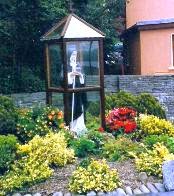
St. Brigit’s Well
            On the day that the Cliffs of Moher was our major destination we stopped enroute at St. Brigid’s Well. There are several spellings of Brigid but I’m using the common Irish spelling. Our guide explained, “Born in the 5th century, Brigid’s mother was a Christian slave and her dad  a pagan chieftain. She and other slaves worked hard, but Brigid was always kind to the other slaves as well as to all animals and birds. She gave her father’s treasured sword to a poor beggar. Although angry at first, her father became proud of  his daughter and came to understand the meaning of charity.
            “Brigid built the first Irish convent by an oak tree and the church in Kildare became known as the Church of the Oak. While explaining the Passion to a dying pagan she wove a cross from rushes found in the River Shannon. Today this rush cross is placed in the rafters of cottages on the feast of St. Brigit to protect the home from evil and want. The feast day is February 1, the day Brigit died in 524. She died in Kildare. Her bones are buried with St. Patrick in Down Patrick.”
            The area is nicely landscaped and a bronze stature of Brigit stands near the well. It’s been a sacred place for centuries. It’s peaceful and quiet and seems to be in the middle of nowhere, but is actually in County Kildare not far from other activities. It is not a must see shrine or on many tourist lists, but is worth a visit, especially if you are motoring through the countryside.

Cliffs of Moher
            The majestic flat-topped ‘mountains’ known as the Cliffs of Moher rise vertically some 650 –700 feet out of the sea and are a breath taking natural site. Five different rock layers can be seen in the strata of the formations. Running five miles, north to south along the coast they are one of Ireland’s signature landmarks. O’Brien’s Tower, a brooding sentinel, is built on the cliff’s highest point. The walled steps to the right of the tower paralleling the cliff’s edge were built in 1835 by Cornelius O’Brien, the proprietor of the land.
             Remarkably the area supports large numbers of seabirds and puffins where black shale and sandstone provide sheltered ledges for the birds to nest.
            A new visitor center was being built so we had to maneuver around a fair amount of construction. The new visitor center is being built into the hillside and will be quite well camouflaged to blend in with the environment. It will be considerably larger than the present center and will house a cafĂ© as well as a gift shop.     We walked up a long moderately steep incline for good viewing. It was a bit misty, but not enough to warrant opening an umbrella. The path to the Tower was closed.
            The cliffs are a popular tourist site and are really quite amazing. We saw many birds flying about, but unfortunately I was not able to identify them, as I’m not much of a birder. From all  that I’d read, I looked forward to this visit and was not disappointed. Riding the country side in a van to get there was an added plus.


Sunday, June 8, 2014

CURIOSITIES

                                           Odds and Ends
  
            In 1974 a group of  Danish airline pilots bought a 1785 grain warehouse and remodeled it into the Admiral Hotel. On a second trip to Copenhagen I stayed at the Admiral. Located on the waterfront in the heart of the city, it was unique and lovely. The original granary had a rustic charm. The thick brick walls had exposed beams and the graceful brick archways were accented with 12 X 15-inch beams 200 years old. They sure built things to last in the old days and Danes save and recycle a lot of their old buildings and what a wonderful job they do of it! The hotel now is owned by a large hotel chain.

Weeping Soldier
I have visited many war memorials, cemeteries and eternal flames, but one memorial that really touched my heart was the weeping soldier in Viden, Bulgaria. The bronze statue portrays a soldier sitting on the battlefield with head bowed weeping for all the victims killed that day in battle. It is an unusual statue as most soldiers are depicted on their horse. I’ve tried unsuccessfully to find out more information about the statue. I believe it was erected in honor of WWI soldiers.

A Favorite Food
            It was a Sunday when I visited St. Andrews, Scotland. After visiting the famous golf course, which is closed on Sunday, and stepping on that legendary 18th green, we took off  to walk about the small town. I can’t resist foreign grocery stores, so when I spotted one, I had to have a look-see. My favorite berry of all time is the raspberry, so when I spied the fresh big berries I had to buy the pint. We strolled down the main street and I ate a berry with every  step. I did offer them to my friend but she refused. By the time we reached the street corner, the berries were gone, hopefully they were organic and clean, but it didn’t matter the box was empty! The trash can on the corner was waiting for me to discard all evidence. I so enjoyed my indulgence!

A Naughty Boy
Walking down the Royal Mile in Edinburgh, Scotland we stopped at the Deacon Brodie Pub to see and admire the lovely ceiling we’d heard about. The ceiling is low for an old building. It is wood with outlined squares of raised thistles and red rose motifs. It  is truly gorgeous. Brodie, the son of a cabinetmaker, was born on Brodie Close.  The wealthy pious citizen was elected to Deacon Counselor in 1781, but at night he turned into a gambler and thief.  He carried a wax plug in his pocket to press key impressions. Then when he knew the residents were not home, he used a newly made key to enter their home to steal jewelry and money. He actually was an inspiration for Robert Louis Stevenson's Jekyll and Hyde. Eventually he was caught and hanged at St. Giles in 1788. In a twist of fate he was hung by a gallows, which he had improved upon. Both his birthplace and death place are close to the tavern named for him.

And Your Age is…..
            We were told that in China they are not shy about asking anyone their age. I happened to be the oldest in our small group and after our hostess  learned this she assumed I was feeble. As we ascended a flight of stairs she grabbed my arm and nearly hauled me up the stairs. They respect age in all facets of life. Younger people yielded seats, right of way etc all the time. It was kind of nice!

Monkey Business
            At Manuel Antonio Beach in Costa Rica the light sand is fine, and the turquoise blue water clear and calm.  A group of squirrel monkeys came from the trees to the beach to visit some sunning tourists. Several carried a baby on her back. Playful they entertained us for some time. One woman was surprised when a monkey approached her towel and stole a cracker from her package then scampered off to eat it. Squirrel monkeys travel in groups and like lower tree areas. They were fearless and so much fun to watch.

More Monkey Business
            On one of my visits to the Schonbrunn in Vienna I stood in front of a painting of a lovely lady with a monkey on her head. The docent explained that centuries ago it was common for people not to bathe for months and inevitably little critters set up housekeeping in women’s long hair. The monkey provided income for its master as he made his rounds and relief from itching for the fair ladies!

Wednesday, June 4, 2014

NOVA SCOTIA'S ARCADIAN COAST


                                           Picturesque country

North America’s tallest church steeple
St. Mary"s Church
At St. Mary’s Church on Nova Scotia’s Arcadian coast a local docent said, “This church is thought to have the tallest wooden church spire in North America. Built in 1903-05, the gray shingled church cost $54,000 to build; a recent re-shingle job cost $250,000! Forty ton of rock at the base of the 185-foot tall steeple helps to stabilize it from swaying when strong winds blow in over St. Mary’s Bay. The original steeple was 212 feet high, but a 1914 fire destroyed the top 27 or so feet and has never been replaced. Acadians are known for building awe-inspiring church spires, and this church is no exception.”
The columns inside the airy and bright church are plaster covered tree trunks and most unique.
No one really knows where the altar was intended to go because some well intentioned soul, nearly a century ago, simply took it off the dock, went through customs while a customs agent looked the other way, and delivered the altar to the church. The organ in the church was originally ordered for the university, but when it arrived it was too big for the intended space, so St. Mary’s and St. Anne’s simply switched organs. The church paid the university one dollar for the 990 pipe organ.
The University of Sainte-Anne is located next door to St. Mary’s. Nova Scotia’s only French-language university was founded in 1891 by French priests, and today is the center of Acadian culture in the province. St. Anne’s is a small college having only 300 students. Nova Scotia has more universities per capita than any other Canadian province.

Digby
            A little farther north on the west coast is the small village of Digby, home to the world’s largest scallop fleet. In 1783 Admiral Robert Digby led a group of loyalists, by sea from the states, to settle here.
Fishing is the major industry in this small seaside village of 2300 residents, and scallops are the symbol of St. James. By the way scallops live in the ocean, and clams live in tidal basins. The area of the Bay of Fundy has extreme tides and at low tide all the fishing boats sit on the bottom of the bay until the tide returns to float them again. The record tide is 52 feet! More water pours into the bay than empties from all the rivers in the world combined. It is amazing to watch the tide come in.
The town’s shipbuilding heritage is evident in the Trinity Anglican Church. Built in 1878 it is thought to be the only church in Canada built entirely by shipwrights. Their unique handiwork is shown in the laminated arches, braces and hand-wrought ironwork so common in ships built over a century ago.

Sunday, June 1, 2014

GHENT'S SITES


                                       A Lovely Ancient City
Ghent is an old city in Belgium, not the fellow who holds a door open for you. It is a lovely ancient city with much to see so I shall endeavor to tell you some of the highlights.
Cloth Hall Tower
The Cloth Hall (Lakenhalle) is a gorgeous 14th century building. All cloth made within a mile of the boundaries of the town had to be brought to the cloth hall. Here, the textile was inspected and measured by three inspectors. The construction of the hall started in 1425 and by 1441, only 7 of the 11 planned bays had been completed.  Since the cloth trade was past its peak, it was useless to finish the building, so all work stopped, but the incomplete cloth hall served other purposes. Since 1613, the municipal fencing-school and the militia guild of Saint-Michael were installed on the first and second floor. From 1742 to 1902, the crypt served as the town jail. The remaining 4 bays were not added until 1903. Old 14th and 15th century textile warehouses line many of the canals.
The 91-metre-high belfry of Ghent is one of three medieval towers that overlook the old city center. Through the centuries, it has served not only as a bell tower to announce the time, but also as a fortified watchtower to announce various warnings to the town. The other two towers belong to Bavo Cathedral and St Nicholas Church.
Construction of the belfry tower began in 1313 and continued intermittently through wars, plagues and political turmoil and finally was completed in 1380. Near the end of this period the gilded dragon, brought from Bruges, assumed its place atop the tower. The uppermost parts of the building have been
rebuilt several times, in part to accommodate the growing number of bells. The primary bell in the tower, Roland, was the one used by citizens to warn of an enemy approaching or a battle won. Roland has become almost a person to the people of Belgium. He is a patriot, a hero, and a leader in all rebellion against unrighteous authority. After conquering Belgium, Charles V ordered the removal of Roland. Henry Wadsworth Longfellow referred to Roland in one of his poems.
A small annex dating from 1741, called the Mammelokker, served as the entrance and guard's quarters of the city jail that occupied part of the old cloth hall from 1742 to 1902. The name refers to the sculpture of Roman Charity poised high above the front doorway. It depicts the Roman legend of a prisoner, Cimon, who was sentenced to death by starvation, but survived thanks to his daughter Pero, a wet nurse who secretly breastfed him during her visits. Ultimately he gained his freedom
A Ghent city view
Saint Bavo Cathedral is the seat of the diocese of Ghent. The building is based upon the Chapel of St. John the Baptist. The primarily wooden structure was consecrated in 942. Traces of this original structure are evident in the cathedral's crypt. The chapel was expanded in Romanesque-style in 1038. Some traces of this phase are also evident in the crypt.  During the 14th - 16th centuries, Gothic-style expansion projects were added to the structure. A new choir, radiating chapels, expansions of the transepts, a Chapterhouse, nave aisles and a single tower western section were all added during this period, and construction was considered complete in 1569.
            In 1539, during the rebellion against Charles V, the old Abbey of St. Bavo was dissolved. Its abbot and monks became canons in a Chapter attached to what became the Church of Saint Bavo. In 1559, the church became a cathedral.
The cathedral is noted for its altarpiece, formally known as: The Adoration of the Mystic Lamb. This work is considered Van Eyck's masterpiece and one of the most important works of the early Northern Renaissance, as well as one of the greatest artistic masterpieces in Belgium. Several of the paintings were sold and went to Germany. Germans stole other panels. The Versailles Treaty required Germany to return the pilfered panels as well as the ones that had been sold.
The cathedral is huge. Lovely stain glass windows, many pieces of statuary and art as well as lots of fresh flowers made for a very pleasing experience. We stopped for some time to listen to a fellow playing the harp.
When done in the church we went across the street to see part of the ancient city wall which is below street level and now houses a small store. The wall parts were in good condition and well built.
The Town Hall in Gent is called Stadhuis in Flemish and Hotel de Ville in French. It is one of the most breath taking buildings in Ghent. A portion of the building has an ornate Gothic design while another portion, on Botermarkt Square, is built in  Renaissance style.
Ghent is a lovely city and demands a good amount of time to visit. It is very walkable. It would be worth hiring a good docent to learn much of the city’s history.

Wednesday, May 28, 2014

FRANCE'S LOIRE VALLEY


                                         A Charming Area
           
The Loire Valley was once the setting for the French court. This chateaux country is where England battled for the control of France. It was an area of great opulence during the 16th century. In the land where Joan of Arc triumphed, today it is a region of lovely chateaux and parks. The Loire Valley is rich with meandering streams, patchwork fields, cool forests, majestic oaks, quiet roads, and lush green countryside. Its royal châteaux and pastoral villages grace its overwhelming natural beauty.   Picturesque cobblestone streets and breathtaking architectural masterpieces provide tiny discoveries hidden in the inviting gentle folds of the landscape. Agriculture includes vineyards, feed corn and sunflowers. The area is known for its white wine.
Each small town seemed to be more picturesque than the previous one. We enjoyed crepes in Tours after determining with a waitress who spoke sporadic English that scratched eggs were indeed scrambled eggs. There’s nothing better than a yummy dessert crepe to top off a lunch at a French sidewalk cafĂ©! 

The impressive Chateau de Chenonceaux--- a jewel of renaissance architecture, graces the pretty town of Amboise. Sitting peacefully on the banks of the Cher River, Chenonceaux is well-known for its traditional French gardens and rich history. The grounds and river are a spectacular backdrop for the impressive structure. The estate of Chenonceaux is mentioned for the first time in writing toward the end of the 11th century.  From the 13th to the 15th century, the estate with its unprepossessing feudal manor was the property of the Marques family.  In 1411 a royal order to punish Jean Marques for an act of sedition included an order for the destruction of the manor.   In 1432 Jean Marques had a castle and a fortified mill built to replace the lost manor.
The ceiling was different in each room. The chateau is full of beautiful large tapestries. One was quite unusual because it was done in tones of blue. Three of the huge marble fireplaces were carved and gorgeous. The rest of the fireplaces in the home were large but plain. The floors were generally tile, but one room had a floor design made with orange and rust 3-inch tiles. The big hall was done in 12-inch black and white tiles. The white ones were a porous material and the tiles quite worn. The kitchens were in the basement. The three floors of the chateau were accessed via winding staircases with rope hand rails.
            We had good views of the gardens across the mote from rooms on each side of the castle. They are extensive, gorgeous and I have no idea how many gardeners it takes to keep them.
            I once thought about biking the Loire Valley, but after seeing it another way I’m not sure I wouldn’t be stopping so often enjoying it all that I’d never finish—but that wouldn’t have been so bad. If you’re ever in the Loire Valley allow yourself plenty of time to visit castles as I’m sure any one you chose will be well worth your time.