Showing posts with label terminology. Show all posts

Sunday, March 27, 2016

KIEV, UKRAINE


                           A Visit During Happier Times 
      With all the recent problems in Ukraine I do not want to get into politics. My goal is to share the wonderful time we had in this lovely city before venturing on to Russia—before Putin regained power. My many Russian readers may or may not agree with me, but all I can do is relate my personal experiences. Three years prior to my visit I had breakfast one morning in Winnipeg, Canada with a Ukrainian business man. He was friendly and talkative and I enjoyed his company. I remember that he impressed upon me that when referencing Ukraine it was exactly that---not THE Ukraine or The Canada. I have passed that on many times, even a couple of times to reporters who were not in the know.
      Ukraine, slightly smaller than Texas, is Europe’s second largest country, and the largest country of what once was the Soviet Bloc. Ukraine was the most populous and developed republic of the USSR. Its longest international border is with Russia on the east. Balarus borders the north. To the west lie Poland and Slovakia. The Black and Azor Seas border the south, and on the southeast are borders with Hungary, Romania and Moldavia.  Besides Ukrainian, other languages spoken include Russian, Romanian, Polish, and Hungarian.
      Russia dominated Ukrainian history for centuries, but the Ukrainian culture stretches even farther back in history. The country was the center of the first Slavic state, a powerful nation called Kievan Rus, which dominated Europe in the 10th and 11th centuries. Invasions by Tartars and Poles weakened the country throughout history until 1654 when Ukraine joined the Muscovy.    
     Ukraine covers less than three percent of what was the USSR landmass, but its rich black soil produced over a third of the Soviet food supply while its mines produced 50 percent of Russia’s iron ore and 25 percent of its coal. 
      Brief independence for Ukraine followed the czar’s abdication in 1917. The Bolsheviks began a brutal civil war in Ukraine that ended with the Soviets taking most of the country and forcing it into the Soviet Union. Eight million people died when the brutal Soviet rule orchestrated artificial famines in 1921-22 and again in 1932-33. 
      Stalin made a vicious attack on Ukrainian culture by exterminating a large part of the intelligentsia. It wasn’t long afterward when horrific fighting between the Germans and Russians took place on Ukrainian soil during WW II, killing an additional eight million people. Large numbers of Russians were encouraged to move to industrial regions of Ukraine and soon became a sizable minority of 11 million. During communist rule the Soviet Union imposed the Russian culture and language onto all Ukrainians. But in spite of this the Ukrainian culture, which stretches far back in history, managed to survive. Even with repression, suffering, political turmoil, and ecological disasters Ukraine’s spirit and national identity have never died.
       The 1986 Chernobyl nuclear disaster and the slow Soviet response embittered Ukrainians. A small nationalist movement, founded in Kiev in 1990, contributed to the country’s independence in 1991.
      The ancient city (5th century) of Kiev is known to Russians as the ‘Mother of Cities’, due to its long and prominent history. A river city as well as the country’s largest city, Kiev also is the capitol city.
      Kiev had established trade routes with Western Europe and Arabia when Moscow was still a village in the woods. In 988, during the golden age, Kiev’s Prince Vladimir gave Orthodox Christianity its Slavic foothold with a mass baptism in the River Dnieper.
       Modern Kiev combines three 9th century towns: Podol, the lower town closest to River Dnieper, Pecherch, and Staro Kiev, site of the modern center. Since independence Ukraine has experienced many traumatic growing pains as a new democracy.
     Transportation includes trams, trolleys, buses and the metro and transfers are allowed from line to line.  However, Kiev is not a pedestrian friendly city. Crossing the street can be hazardous to one’s health and is the best incentive for using the underground passageways/tunnels to get from one side to the opposite side of the street.
      Old Kiev with its narrow streets and small shops is the heart of the city. Merchants and craftsmen worked and lived, often for a lifetime, in the same small area. Kiev is known both as the Garden City and as a Green City. A large part of the city is park area.  As we got around the city, I realized that the city of three million people seemed like a small large city.
      After the Danube and Volga Rivers, the Dnieper River is Europe’s third longest river. Flowing through the city of Kiev, it also flows through Russia, and  Belarus to the Black Sea.
     Our local city guide pointed out art nouveau buildings, Stalin-era buildings that generally had a large star on top, many of the city’s 80 churches and numerous 11th century well-preserved buildings. Kiev is both the modern gateway to Ukraine and a historic town that blends commercial streets with modern byways with its old town. The city is the place of presidential administration, parliament and government departments. Actually Kiev is twice as old as Moscow. Spellings of buildings and streets can be very confusing as there is almost always at least two spellings for any one place or street.
     At the 170-year-old Red University all the walls and buildings are painted a terra cotta red. Across the street is a large bronze statue of the famous Ukrainian poet, Shevchenko. He stands just inside the entrance of a park bearing his name ---an island of greenery in the middle of bustling down city.
     The old city gate, built 1017-24 by Prince Yaroslavl meant to underscore his country’s power. Under Yaroslavl’s rule the city increased ten-fold. Nomadic tribes never could penetrate the main gate to the city. During the 16th and 17th centuries the gate deteriorated and in the 18th century it was covered with earth. In 1832 archeologists discovered the ruins and a portion of the gate was restored and protected behind an iron fence.
      Kiev’s main business district, Khreshchatik, was blocked off for the holiday, so we strolled down the center of the wide street lined with large old trees and grand monumental buildings interspersed with small shops. It was a beautiful warm day.
      Independence Square, where the Orange Revolution took place when the presidential elections were so hotly contested, was lovely. We had a wonder couple days in Kiev, ate some wonderful borsch and enjoyed delightful weather and the friendly people. I was heartbroken when I heard on the news that the square was again the site of protest and that much of the paving stones had been dug up. I feel  lucky to have been a visitor during happier more peaceful times.

Sunday, February 8, 2015

SUB-ARTIC TUNDRA


             A Whole Different Ecosystem
In spring, the tundra is vibrant with life when more than 400 species of native plants burst into a rainbow of color; a magnificent sight after a long gloomy dreary winter! By fall, the tundra is covered with scarlet bearberries and yellow willow shrubs. Interspersed among the color, one may find downy white fluffs of arctic birds. The dark winters and the harsh Arctic climate produce a poverty of the soil, and a hostility to life.  We were told that bugs and black flies are really terrible for about six weeks in the summer.
Less than ten species of birds live year round in the Arctic, however, about 100 bird species breed there, but head south for the winter. Of the 30,000 species of fish less than 100 live in the northern seas. There are no reptiles.
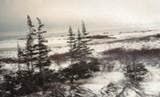
BIG trees on the tundra
By fall all Arctic life prepares for winter.  Urged on by special hormones, birds feed incessantly to build fat reserves, for the long flight south. Ground squirrels, who have already doubled their weight, stock dens with a food supply. Arctic foxes also cache a winter’s food supply. Caribou have produced 1/5 of their body weight as fat. Plants store lipids in their roots and rhizomes to await spring. Insects produce a glycerol-like anti-freeze, efficient enough to survive temperatures of 70 degrees below, and spend the winter in a suspended animation.
I never visualized water on the tundra, but we saw many frozen ponds, some as small as a 10 X10 foot puddle, but many were quite large.     The frozen water areas are called thermal karst. In summer they are all liquid water in a soggy tundra, and in winter a frozen pond.
Both the federal and provincial governments strictly regulate the tundra. Running over the tundra like a wild off-road vehicle is strictly prohibited.
An esker is a narrow raised area on the tundra that has long been the highway of the tundra.  The permafrost of the tundra is only 6-12” below the surface. 
Taiga (tee ga)  means small sticks, and the area has long been known as the land of small sticks.  Because of the permafrost and shallow growing area, trees send up shoots vs. digging the roots deep. It’s easy to find north, as there are no branches or foliage on the north side of the trees. The trunks are small.
The low stuff growing was willow. It grows in fair abundance, is 18”-48” tall, and has yellow blooms in the fall.  Other small plants in various colors also grow on the tundra. Their blooms are also small. Lichen, which grows very slowly, can be seen in black, yellow, or orange growing on many of the rocks.
The tundra is an interesting ecosystem and I enjoyed learning about it, especially since we were riding over it each day in a tundra buggy!


Sunday, February 1, 2015

POLAR BEARS

                                      I Hope They Will Survive


Mid October each year, 600-1000 polar bears gather along 100 miles of coast, stretching from Nelson to Churchill, Manitoba. It is the largest concentration of polar bears in the world. About 300-350 bears congregate in the Churchill area, waiting for the bay to freeze over.( I hope this will continue to be true!)

The indigenous people, the Inuits, called the polar bear Nanook. The Ursus Maritimus is the world’s largest terrestrial carnivore. The King of the Arctic, is a gentle, ever caring mother, who has an intense curiosity. Females weigh 500-700 pounds, and males from 1000-1500 pounds.  Standing on its hind legs, some bears can reach a height of 10-12 feet!

Clad in insulating fur and fat, the polar bear is able to sleep through blizzards, or plunge into near freezing arctic waters. The bear’s three layer coat consists of a big layer of fat topped by skin. A thick black under coat of dense fur traps heat. The top layer of fur consists of guard hairs, which are hollow and act as a solar collector, trapping the warm rays of the direct sun, and passing them onto the heat trapping under coat. The 4 inch outer coat appears from white to yellow, but in effect, its hollow hairs are actually transparent reflecting light. These hairs, also add buoyancy when swimming, and the matting ability and oily texture allow the animal to shed water and ice from its body.

The animals’ paws are large and rounded.  The bear is capable of flipping a 500 pound seal, from the water, with one swing of its paw! Each paw has five partially webbed claws that assist in swimming. Using the front legs to propel him, and its hind legs to stabilize and steer, the bear is a strong swimmer, able to swim up to 60 miles before needing to rest. The footpads have a heavy fur coat, to protect against frostbite, but are rough enough to add traction on ice. On solid surfaces, the paws spread to distribute weight and act like a snowshoe, making them a master at negotiating over ice.

The head is long and tapered, with small ears and powerful jaws. The 42 teeth include long sharp canines, needed for piercing flesh. Their eyesight is rather poor, except under water, where they can see 15 feet, when looking for food. They tend to be far sighted, which allows them to search large areas of their environment when feeding. Their hearing, through the small fur lined ears, is nearly equal to that of humans. The ears also contain a fine network of blood vessels, which transport thermal energy to the auricles.

     The polar bear has a phenomenal sense of smell, and it is said, he can smell a seal buried in a cave, under three feet of snow.  The bear is often seen thrusting its nose in the air to utilize its keen sense of smell. The animal, not only can smell through 3 feet of ice, but also for a distance of 10 miles. On a clear day, through binoculars, its black nose can be seen from a distance of six miles!

The polar bear liver is so rich in vitamin A that it is toxic to humans. The bears are also susceptible to a parasitic worm, which is apparently contracted from eating infected seals. A grown bear’s stomach will allow him to consume 150 pounds of food at one time! However, on average, a seal every five days is adequate to sustains a bear. Summer produces slim pickings for food, and the bear pretty much subsists on its own fat. The normal walking gait of the bear is 2 ½ miles an hour, but it is possible for him to run 25 miles an hour.

Spring, April–May, is mating season for polar bears, with the pair remaining together for a week. Courtship and mating take place on the ice.  Polar bears are induced ovulators, meaning that they do not ovulate regularly, but the mating ritual stimulates ovulation. Gestation is eight months. Mothers normally have twins, but can deliver one or up to four cubs. Cubs look like rats at birth weighting, only 1-2 pounds. When born they are hairless, blind, deaf, and helpless. By the time they emerge from the den at five months, they generally weigh 29 pounds. Moms can double her weight during pregnancy. Cubs are born November – February.  Mom nurses her babies for five months, during which time she does not hunt or feed, but stays in the den with her babies.

The size of the den is approximately 6 X 10 X 4 feet, and the temperature is 40 degrees warmer than the outside air.  There are 17 known denning areas across Canada. One, 40 miles south of Churchill, is the largest. Discovered in 1969, it is a birthing den for 150 polar bears. The cubs stay with their mother 2 ½ years. Mother generally gets pregnant about every three years.     Mother’s milk is 40% fat and is thick like condensed milk. At one month, the cubs crawl, at 6 weeks open their eyes, and by 10 weeks, they can keep their balance. They are mature at 4-5 years. The life span of a polar bear is usually 15-18 years, but can reach 30 years. Mothers with cubs are solitary. Polar bears are very good moms. It is not uncommon for her to run off a male, twice her size, to protect her cub.         Polar bears are one of the seven species of bears, and is most closely related to the brown bear, with whom they can interbreed, and produce fertile offspring. An adult female polar bear is called a sow, and a male, a boar. Adult males can be aggressive and often may hurt or kill the cubs. Two males can box over females for hours and the result can be bloody.

      A polar bear can eat 10% of its body weight in 30 minutes! The animals have well developed, strong hind leg and neck muscles. In spite of their size, they are agile in the water. Young males indulge in mock fights, called sparring, which is an impressive pastime. They spend hours wrestling on their hind legs, which will serve them well for survival and the fight for mates, territory, and food. They will lick the snow to quench their thirst. The only enemy of an adult polar bear is the human.

      Polar bears wander the frozen north and are constantly on the move, roaming hundreds of miles.  They live on ice sheets and ice floes, which provide a base for their diet of mostly ringed seals.  They’ll often wait for a seal to stick its head out of the water to breathe, then slap the seal on the head with its paw, and drag it from the water. This technique is called still hunting.   The aquatic stalk is another hunting technique; the bear quietly swims through the water where a seal is sun bathing on an ice floe. The bear suddenly leaps out of the water grabbing the seal by the neck, and before the seal knows what is happening, he has become dinner. They also eat stranded whales, walruses, carcasses, human refuge, and in the summer, plants and berries.

      We saw many polar bears during our stay in Churchill and it was a thrill every time!