Showing posts with label People. Show all posts

Sunday, April 17, 2016

LABRADOR

Big but Rural
 
      The MS Apollo is a large ferry and at first we wondered why it was coming into the pier bow first. Suddenly the bow of the ship started to open and I remarked, “The whale is opening its mouth!” After the bus was parked in the ferry’s bowels, a crew member met us to escort us up the stairs to the lounge and then returned to escort those who were using the elevator. The crossing was smooth but it was so foggy and misty that you could hardly see the water from the top viewing lounge. The radar kept rotating and the fog horn blew regularly. There was no hope of seeing an iceberg and we just hoped we didn’t hit one! The crossing of the Strait of Belle Isle from Newfoundland to Labrador takes 90 minutes.
     Labrador is bounded on the east by the Atlantic Ocean, on the south and west by Quebec Province, and is separated from Newfoundland by the Straits of Belle Isle. Labrador is larger but less populated than the better known island. It is remote and undeveloped except for small ports on the coast and a few towns inland.
     Wildlife abounds among the spectacular scenery where culture and heritage is unlike anywhere else in the world. Newfoundland is often referred to as The Rock. Much of the country is considered rural, but a modern vibrant society still retains its Old World charm with a story to be told or a song sung in every bay.
     Labrador is the home of the largest caribou herd in the world. Isolated from the rest of province, it has remained wild. However, Goose Bay has all the amenities of an urban area.
The soil is red and much more plentiful than in Newfoundland. The terrain is different and very green and lush. Larch trees are numerous and the area reminded me a lot of the Scottish highlands.
     Labrador is French meaning arms of gold. In 1520 Fernandez, a Portuguese traveler and landowner, spotted Labrador but did not land. Labrador’s population of 27,000 is spread out over its 300 square kilometers, so the whole area is very rural. Labrador is two and a half times bigger than Newfoundland. The people are proud and self reliant. Innu and Inuit peoples have lived in Labrador for thousands of years and their cultures are rooted in a deep spiritual relationship with the environment.
     Newfoundland became part of Canada in 1949 as its tenth province and the seventh largest. Less than one percent of the land is owned by the federal government. The province of Newfoundland is divided into four areas: the beautiful Northern Peninsula where Vikings landed ten centuries ago; the Central and Eastern Regions with their wilderness forests and seaside villages; and the Avalon Region featuring the historic capital of St. Johns.
     The island measures 325 miles north to south and 320 miles east to west and is about the size of Virginia. Mount Caubvick, at 5322 feet, is its highest peak. Newfoundland forms the northern extremity of the Appalachian geological province of North America. Glaciation has left its mark on the area with most hilltops having been scraped bare and many valleys and low-lying areas containing a thick mantle of rocky glacial deposits. The main rivers draining the island are the Exploits, Gander, and Humber. Thousands of lakes, ponds, and bogs are found throughout the province. Many long finger-like lakes have been formed in glacial valleys with the Grand, Red Indian, and Gander lakes being the largest. Newfoundland’s west coast is an endless fascinating natural wonder with cavernous fjords, dense forests, tufted heathlands, ancient mountains from Port aux Bosques in the south to L’Anse aux Meadows in the northern tip of Newfoundland’s Great Northern Peninsula.
     We often saw the Labrador flag flying. The blue, green, and white flag has a spruce twig in the left corner of the white strip representing the five regions and the top three needles represent three peoples, Inuit, Innu and the settlers.
    The people have a good sense of humor and don’t hesitate to poke fun at themselves. They even make s spruce beer, which I guess you either like or hate. The Trans-Labrador highway is only paved in three small spurts. Most of the highway is connected by either dirt road or ferry. We traveled the 55 mile-long section to Red Bay. Caribou are native to the area and 600,000 of them roam the province.
     The Labrador Coastal Drive showed us tundra plateaus, rugged coastal headlands, and valleys thick with fir and spruce forests. Small picturesque fishing villages with populations up to 600 dotted the landscape. The fog lifted and suddenly someone yelled, “ICEBERG!” And sure enough in the distance we could see a big iceberg floating. Actually the icebergs were early that year and most of them had already passed.
      Newfoundland and Labrador form one of Canada’s four Atlantic Provinces. A particular combination of geographical, economic and historical forces has shaped its society. The isolated location, marine environment, work patterns and social relationships developed in a fishing economy and the British and Irish roots of the majority of its people.
     English is the first language of 98 percent of the population. Less than one percent speak French as the first language. There are 4700 Native Americans living in the area.
     The Hudson Bay Company set up an outpost in 1752. Moravian Missionaries arrived in the 1770s establishing the first missions in Northern Labrador. They provided religious, educational and social services to the Inuit peoples. They also traded with them and provided a link with the outside world. In the 1760s England sent a governor to Labrador who soon requested naval help and received 5000 men.

Sunday, December 27, 2015

FRENCH REFLECTIONS continued

                                          Other Memories

 License plates were long and the last two digits designated the province or region.

Water was drinkable everywhere.

The lack of protective gear/devices/rules was noticeable and most prominent at the Cognac cooperage.

Most bike paths were about a meter wide and could be scary when meeting an oncoming biker.

In the French countryside we never saw a McDonald’s---had to get to Bordeaux for that.

On another trip to France I learned quickly how important it is to always greet someone with Bon Jour before any further conversation. It is considered very rude to just approach someone and start talking. Twice I forgot this courtesy, did get my answer, but in a very curt way.

Public transportation, especially the metro/ trains, are convenient, quick, clean and prompt and easy to follow. Doors on the train do not automatically open when stopped. One needs to press down the handle. Sure felt stupid the first time we went to get off standing in front of the closed door. An old-timer helped us out.

Site/museum tickets are easily obtained from cigar shops.

     We saw young people in jeans but older women were always in a skirt or dress even in the gardens or fields.
     One scarce item was toilets, and when we did find them they were not all that clean or well equipped. We ran into a couple male/female  water closets equipped with both male and female urinals in the same open spaced room. We learned early that female urinals are very common and there is a technique to flushing them!

    People outside the big cities who were involved in the tourist industry spoke enough English to get by, but others spoke little or no English. Generally the French were pleasant, helpful, friendly and honest. Often they were talkative with a desire to improve their English language skills.
    The people in the Normandie area are very pro American and never have forgotten what we did for them in WW II. They are very friendly to Americans. We ran into and talked to some really interesting people as we traveled around the area in our van


Wednesday, August 19, 2015

HAVANA TID BITS

                                         A Great Visit

       There are many modes of transportation besides the yellow cabs; there are bike-taxis, horse drawn taxis, bicycles, and the adorable cococabs. People hitchhike all the time, especially out of the city. Obviously it is safe to do so and most all vehicles stop to pick up someone if they have the room.
    Traffic never slows. Pedestrians obviously do not have the right of way. However, we never saw an accident. Of course speed limits are slow, probably averaging about 40 miles an hour. There are very few traffic lights in Havana.
    Walking can be hazardous because of the conditions of the sidewalks. Havana has little pollution, which was a pleasant surprise.     
    Music was everywhere, all the time. It is nearly impossible to dine without music. Panhandlers are nearly non-existent. 
    The city is full of parks of all sizes and there are many many statues. Plazas abound. The island is lush and green, and extremely clean. Litter does not exist.
     The only part of the old city wall still standing is near the train station. The harbor had some pretty rusty ships at anchor. In the industrial area there were thousands of containers, many full size, but many also about half size. Also there were many oil storage tanks.
     A toilet seat outside of hotels seemed to be missing much of the time. It was smart to carry tissues or T P when away from the hotel.
     The old cars are easy to maintain. Even though parts may not be available they are easy to reproduce. The Russian cars are often cut up to make trucks or vans.
    Riding through decaying parts of town I noticed wires strung like spider webs out of windows, exposed to the outside, running loop after loop to somewhere else. It made me wonder who paid the electric bill, if in fact such a bill exists. Then again in some of these same parts of town were lovely old wrought-iron railings around balconies, which I’m not sure I’d want to step out onto.
    In the countryside I noted horses, goats, and cows grazing with no restraints and many times no fences. If there was a fence it was a flimsy line or two of wire.
     Cuba is a country of contradictions and surprises. Our trip was extensive getting us well out of Havana. People were friendly. Young people were open and spoke without a sense of fear. I would loved to have stayed a few more days and Cuba is definitely on my return-to list.


Wednesday, November 12, 2014

THE EMBREA PEOPLE


                                    An Interesting Culture
            The name Embera means people. Collectively they are known as the Chocó and belong to two major groups: the Embera, of upper Atrato and San Jaun Rivers, and the Wuanana of the lower San Juan River.. The Darien Jungle is the second largest rainforest area in the world (after the Amazon) and 20,000 Embera live in small groups in the Darien. The jungle serves as a buffer zone between Panama and Columbia. There are no roads in the wild desolate area.  There is a 54-mile stretch called the Darien Gap of the Pan-American Highway that is impassable. Cars have to be shipped.
            Some Embera live in the Canal Zone and can do so as long as they do not hunt or cut down trees. Originally the tribe was hunter-gatherers, but today they live on jungle fruits, heart of palm, and tubular plants such as yucca and fishing.
            The Chocó, or Embera people live in small villages of 5 to 20 houses along the banks of the rivers throughout river watersheds in the Darien Province of Panama. There are generally three villages, about a half day's walk apart, on each tributary that branches off from the main river system. The villages are built on a small rise, set approximately 100 feet in from the river. To avoid wild animals such as peccary and jaguar from inhabiting the homes, houses are built on posts 6-8-feet above ground and are 20– 50 feet apart. The raised floor also gives protection from flooding and allows for cooling of the hut. There are no walls on the palm fond thatched roof huts. The joinery is done with bejuco vines.
            Baskets, pots, bows and arrows, mosquito nets, clothing and other items hang from the beams. They sleep on the floor. The floor is made of split black palm trunks or cana blanca (white cane), and has a kitchen built on a three foot square clay platform that forms a fire base for cooking. A sloped log with deep notches for a ladder provides access to the hut. The notches are faced down at night.
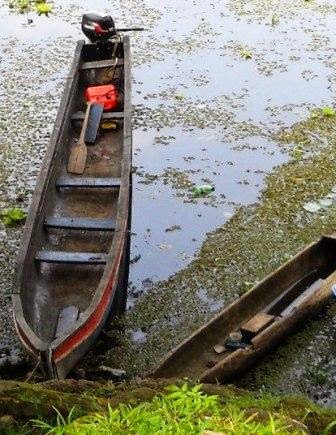
           The jungle is partly cleared around each village and replaced by banana and plantain plantations, a commercial crop for them that provides  cash for their outboard motors, mosquito nets etc. The hills leading down to the river are usually hard packed reddish clay.  Dugout canoes are pulled up on the riverbanks
The land is community owned and community farmed. Everyone in the village pitches in to work at harvest time. The tribe farms and both men and women work in the fields. Women carry corn and grain, but the men carry the firewood.
If one hunter gets a larger animal, such as a peccary, or a tapir everybody shares the meat. These Indians live separately in the jungle. These people are very individualistic and totally apolitical. You deal with them one on one. The Embrea use a flute and a drum to keep beat for their simple dances.
            Small in stature, their skin is a pretty bronze. Health care primarily is provided by trained Shamans. The men wear nothing but a minimal loin cloth. The women wear bright sarongs wrapped at the waist as a skirt. Women generally do not cover their torsos, but wear multi strands of seed beads and wear long straight black hair. The children go naked until puberty, and no one wears shoes.
            They paint their bodies with a dye made from the fruit of the black palm tree. The black dye is thought to repel insects. On special occasions, using this same dye, they print intricate geometric patterns all over their bodies, using wood blocks carved from balsa wood. The paint fades in a few days and is known as the two-week tattoo. The women also wear silver necklaces and earrings on special occasions; many of the necklaces are made from old silver coins. A hole is punched  in the coin and a silver chain run through it. Many of the coins on these necklaces date to the 19th century and are passed down from mother to daughter.
Women weave baskets from leaf strands of the black palm. The tightly woven watertight baskets are called canastas.
The men do some rather good wood carvings from rosewood, known locally as cocobolo. They also carve small figures and animals from the vegetable ivory nut known as tagua. Until 1936 many buttons were made from this nut. The nut is about the size of a small plum, hard, and rather difficult to carve. When polished they certainly look like ivory.
Embera  dances reflect their spiritual connection to nature.
            The Embrea people use matrilineal descent, practice polygamy and live in family units. They have their own form of government and live by their own unwritten rules avoiding the Panamanian Police or any other branch of the Panamanian or Colombian government. Not assimilated into Panamanian or Colombian society, the Embera people do not hold any civic positions and have no members who have become part of the Guardia Nacional in Panama. They do not intermarry with Panamanians and Colombians.

Tuesday, February 23, 2010

MORE FRIENDLY PEOPLE

In Glasgow we were looking for a post office that seemed to elude us.
We asked a fellow on the street where it was, but he was a stranger in town and was just doing some shopping while his wife had her hair done. He was sorry he couldn’t help us. We thanked him and continued on. A couple of minutes later we heard, “Ladies.”
When we turned around we faced the same fellow we had asked directions of. He explained while he was walking in the opposite direction that he remembered where the post office was and proceeded to give us directions. He had turned around and found us to relay that information. How nice was that! As it turned out we were only a block or so away. We entered, made our money exchange and then visited a large department store for a look-see.

Riding the escalator down an hour or so later, the young man standing behind us overheard us discussing finding a restaurant. As we stepped off, he called to us and proceeded to tell us where we could find an arcade of restaurants and recommended a couple he particularly liked. We took his advice and enjoyed a wonderful meal.

When biking in Germany, I was standing outside a bakery waiting for a companion to complete her purchase when an elderly man approached me asking, " Are you American."
 After I said yes, he went on to tell me how during WW II he had been in a concentration camp in the United States. I can’t recall the state, but it was a surprise to me, as I was unaware we had a camp there. He apologized for his English. He told me he had been well treated. What a small world.

In Moscow we were looking for a grocery store to buy a gallon of bottled water. We would be in the city long enough to empty it by refilling our small drinking bottles. Unknowingly we turned back when only two blocks away from our destination. Back on the main street we asked directions of a fellow walking with his wife and small child. The wife ducked into a store with the child, but the fellow tried to tell us, but he spoke only Russian. Finally he decided to show us where to turn, so as he hustled down the street he kept up a constant stream of Russian chatter. Jan kept smiling and shaking her head like she knew what he was talking about. I followed smiling. It was a kind gesture on his part and we did find the store and made our purchase.       His wife obviously was more skepital of strangers.

In Beijing we were returning to the hotel through a lovely little park. About half way, a young man stopped us and asked if we were American. He was a part time guide and was looking to improve his English speaking skills. We had a delightful conversation with him for 15 min or so.

In Melbourne there is a free tram around the center city during certain hours. We knew we were a few minutes late for the free ride, but we hopped on anyway expecting to pay the fare. The lady driver got to talking to us and asked where we were staying, where we were from etc.
She then said, “You’re just a couple of minutes late for the free tram, but just take a seat and make believe you didn’t know there was a time limit.”
We did and she alerted us when our stop arrived. We thanked her.

If you’re ever in a place where English is scarce look for a young person, preferably a male. The young people know English and the boys have a bit of an edge on the girls. At the Budapest zoo everything was written in Hungarian. A couple times we were a bit puzzled by the foreign map. I looked around for a young man and sure enough both times he spoke English and was able to show us where we were. Both times we were close to where we wanted to be, but the reassurance was nice to have!

We have run into so many friendly and helpful people around the world, and because of that we have had some delightful surprises.

Saturday, February 20, 2010

FRIENDLY HELPFUL PEOPLE

I try to blend into my surroundings and not scream tourist when traveling. Occasionally I miss the mark, like the time I was sitting in the stalls at a London theater dressed in a red and white stripped blouse under a red sweater vest. Believe me, I was easy to spot from anywhere in the theater among all the dark colored, drab-dressed Londoners. By the way, the stalls are the main part of the theater, what we would call the orchestra. I normally wear a lot of red, cranberry, and maroon so I have a travel wardrobe of more muted sedate colors for visiting the continent.

I must have a friendly-looking face as I’ve run into the nicest most pleasant people all over the world. In Vienna, Jan and I left our hotel heading for Stephenplatz and hadn’t gone more than a block when a car pulled over to the curb to ask directions. Although we had been in the city only a day and a half, Jan knew what the woman was talking about and actually was able to give her directions. What are the odds of a stranger in town knowing the answer for another stranger in town?

Late in the afternoon of our first day in Quebec City we were walking back down to our hotel when I spotted a couple on the street corner looking a bit lost. We stopped and I asked, “Can we help you find something?” Jan started to laugh saying, “Lee we’ve only been here a few hours. What do you think you can tell them?”
“I know, but we know where a few things are,” I answered.
The couple turned out to be waiting for friends. It was their 4-5 trip to the city for those native Canadians. We chit chatted for a few minutes on the street corner when suddenly the fellow asked, “Where are you eating this evening?"
“We don’t know,” we answered in unison.
He instructed, “If you follow this street to the end you’ll find Portofino Bistro and you’ll have the best Italian food ever.”
We thanked him and continued on our way. We did indeed find the restaurant that was located in a house dating back to 1760. We enjoyed the warm friendly atmosphere and the gracious friendly people. But most of all we enjoyed the superb lasagna. It was certainly a good choice, and one we would have bypassed if we had not spoken to that couple.

In Dublin, we were on our way back to the hotel after a long day of sightseeing when a middle-aged man stopped up on the street saying, “Excuse me. Can you tell me what is behind that fence across the street?”
Again, we knew the answer. “It’s Trinity College”
Then we got to talking. He was a country minister in town while his wife attended some seminar. We talked for 15 minutes or so when he finally asked if we’d like to join him for a drink at some pub. It was a tempting offer as he was an interesting man, but it was the end of a very long day and we were both tired. Anxious to get our shoes off and to relax we declined his invitation.

In city after city when people saw us looking at a map or puzzled at some street corner, they would ask if they could help us find something. We always found their advice and information helpful. I guess we must have looked enough like Americans as we were always spoken to in English.
In Auckland late one afternoon we hopped on a bus to go back to the stop near the hotel where we’d boarded the bus hours earlier. The friendly bus driver got talking to the four of us. Instead of dropping us off at our stop he drove us to the hotel's front door. Maybe we looked tired, but we sure appreciated his kindness and consideration. What a nice thing to do!