Showing posts with label Gardens. Show all posts

Wednesday, December 2, 2015

VERSAILLES BASICS

                                          One Huge Palace
       
         We decided to take the train from Paris for the hour ride through the countryside to visit the  Château de Versailles. Before heading to the subway we stopped in a cigar store to purchase a two-day museum pass. On arrival and seeing the long line to buy tickets,  we were especially glad we already had ours! It was nice to bypass the line and go directly to the side and enter the chateau where the first stop was reception to buy English ear phones and pick up a map.
            Chateau Versailles is a bit of a misnomer, as it is truly a magnificent palace radiating wealth, grandeur and ceremony. A UNESCO site for the past thirty years, it is an excellent example of 18th century art. Louis XIII built Versailles as a hunting lodge.  Louis XIV expanded the structure and moved the court and government there in 1682. Three French kings occupied the 18,000 square meter palace---the seat of power until 1789.

The château also includes lavish royal apartments and the Châteaux de Trianon, Marie Antoinette’s hamlet. Magnificent gardens, 250 acres of them, surround these monuments. In the 16th century the area was a clay quarry for making tile. Catherine built the palace after Henri II died in 1559. The Italian style reminded the queen of her native Tuscany.

Between 1660-1994 the palace was redesigned in French style. a renovation took place in 1990, statues were added and the palace was separated from traffic. In 1994 a foot bridge was added across the Seine River.

The palace tour starts at the Louie XV chapel, completed in 1710. The two-level room faces the east and the rising sun. The king sat in the top level, his family to the sides and the public on the ground floor. Mass was held every day.

            Marble wainscoting and wooden parquet floors were in the apartments. The gorgeous salon ceiling, containing 142 figures, took three years to paint. Belgium marble in a quilt pattern edged the contrasting colored marble walls. The 236-foot long hall of mirrors in the grand apartments dates back to the 1670s. There are 17 multi paned mirrors, gilded together rather than soldered, on the inside wall of the long room. Seventeen arched windows are opposite on the outside wall. Three rows of crystal chandeliers go the full length of the hall, plus there is a row of gold statues on the side walls holding up additional chandeliers. Large red, grey and gold tapestries hang on the king’s bedroom walls. To say this part of the palace is ornate, and busy, is a bit of an understatement!    
             The dauphin (oldest son of the king) apartments, dating back to the 1670s, were much prettier and calmer. The white walls had lovely painted raised, probably plaster, decorations running around all the edges. Forty-three coats of alternating paint and varnish covered the decorated parts. These rooms, apartment if you will, were a contrast to what we’d seen, and although I loved them, they were occupied by a male and seemed very feminine to me. 
            We walked through the gardens to catch a little tram ride through the forest to Marie-Antoinette’s apartments where she raised sheep. Her quarters were peaceful in a quiet setting. Marble was popular and she had some unique furniture pieces. It was easy to see why Marie-Antoinette (1755-1793), an Austrian princess and brother of Emperor Joseph II as well as the wife of Louis XVI, would love to stay here. She had a flair for entertaining. Besides raising sheep, she was a music and art lover and played the harp.
            In the 19th century Versailles became a museum of French history. 

Sunday, July 26, 2015

VICTORIA, BRITISH COLUMBIA

                                  A Charming City

    Victoria is located on the southern tip of Vancouver Island, across the Strait of Juan de Fuca and Washington’s snow capped Olympic Peninsula. This island city is a romantic, quaint seaport. Victoria enjoys mild Mediterranean weather with low humidity and off shore breezes, and gets 20-25 inches of rain a year, about a third of Vancouver’s rainfall.
The city, named for a queen, is known as the City of Gardens, and beautiful gardens bloom year round. Elaborate rose gardens flourish in the mild climate. Down town, baskets of flowers hang from the 19th century lampposts in summer, sprouting about mid-May. They add beauty and atmosphere to the waterfront of the already charming city.
In 1843 Victoria was settled as a political choice to secure an English border with the US. Actually Victoria sits below the American-Canadian border.  The city flourished when gold was discovered in 1858.  Gold seeking miners outfitted at Fort Victoria in the mid 1850s. During the gold rush there were 57 offenses that demanded hanging. It was a booming colonial city in the late 19th century---until Vancouver was established in 1880s. James Douglas became the first Governor. He gave the city 150 acres of land which now is Beacon Hill Park. Established as a Hudson Bay Company Fort the city is a mix of old England with a proud history and British customs.
The first commercial brewery in Western Canada was established in the 1850s and was in operation before the first lighthouse. There are many vineyards on Vancouver Island making for a burgeoning wine industry.
  Today horse drawn carriages trot past stately legislative buildings.  Historic Fort Street is known as antique row in this modern metropolitan city.  London-style double-decker buses transit the city on a regular basis. Pedicabs and ferries are also available. Local transportation is frequent, reliable and easy to follow, and walking the compact city is easy as well. Float planes take off every 2-3 minutes making for a busy harbor.  This wonderfully preserved frontier town sits in a beautiful scenic seaside locale. Victoria is the island’s largest city as well as the Provincial capital. The rest of Vancouver Island is rural to wild.
The Gorge is a long body of water, a tidal basin, that at the turn of the century was the playground for well-to-do Victorians. Many lovely old Victorian homes were in the area. Unfortunately only a couple remain. 
Lt. Governor’s house has 35 acres of gardens! Budget cuts years ago transferred all the gardeners from the house. After twelve years of neglect the gardens were in a sad state of disrepair. In 1990 a large group of volunteer gardeners was organized who now care for the gardens that are again lovely. Several volunteer gardeners were working the morning we visited and I had a chance to talk to a couple of them. The city parks have unionized gardeners and do not encourage any volunteering----what a shame!
The University of Victoria’s gardens were exquisite! Azaleas and rhododendrons were in full bloom, in every color. Some of the rhododendron blossoms were the size of a large dinner plate, and standing six feet tall they were a magnificent sight!
It seemed every home in the city had a flowering garden of some size and they obviously take great pride in their landscapes
Oak Bay, which is one of Victoria’s most British-looking villages/ neighborhoods. Many of the homes were built from stone used as ships’ ballast. Much of the iron trim was also used as ballast. Many old stone walls are still standing and were lovely. We wandered around a bit in some of the shops, and the last evening we had dinner at the Blithering Pub in Oak Bay. In one area of town each street is lined with a different kind of tree. Most neighborhoods in Victoria have lovely old trees. Each little village has its own small grocery store and local pub, both of which are part of the village charm.
Craigdarock Castle
Early railroad and coal barons built many luxurious castles in Victoria. Robert Dunsmuir emigrated from Scotland and became an empire building coal baron. He built Craigdarock
Castle, a lavishly furnished 39-room castle in 1887.  The stained glass windows in the castle were exquisite. The ornately carved woodwork was beautiful as were the fireplaces, pink granite columns, stone turrets and the parquet floors, with a different design each room.
We climbed the 87 steps to the top of the tower, which rewarded us a good view of the city below. We stopped on each floor to view various rooms. We descended down stairs that led through the servants’ quarters.
The original estate extended to the water covering 28 acres. Mr. Dunsmuir died months before the majestic castle was completed, but his wife and children moved into the castle and lived there until his wife, Joan, died in 1908. At that time the castle was a white elephant that no one wanted. Eventually the acreage of the castle was subdivided into 120 lots and sold.  
 Over the years the castle has been used as a military hospital, housed Victoria College, the School Board offices, a conservatory of music, and finally today is an historic house museum.
Victoria is a charming city with a lot of history and much to see and do.

Visit post 8-8-12 to read all about the fantastic Parliament bldg
            Post    10/27 /13 for a look at the Empress hotel and hi tea there.


Wednesday, October 22, 2014

MONET AND GIVERNY

                         Monet's Home and Garden
                          
      I was excited to learn we were going to make an unscheduled stop—to Monet’s home and gardens! The highlight of this trip was Normandy so it was a real bonus.
      Claude Monet noticed the village of Giverny while looking out of a train window. He made up his mind to move there and rented a house and the area surrounding it. In 1890 he had enough money to buy the house and land outright and set out to create the magnificent gardens he wanted to paint. Monet lived in Giverny from 1883 until his death in 1926. He and many members of his family are interred in the village cemetery.  
      Following restoration, Monet's house and gardens were opened to the public in 1980.We wandered around the lily ponds first and over the stream bridges. The beautiful gardens were so quiet and peaceful. Still
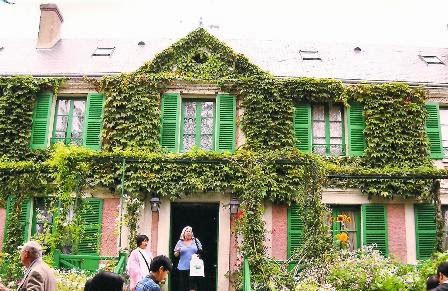
Monet's home
in bloom the gardens were a profusion of color. Sunflowers were 7-8 feet tall with blossoms the size of dinner plates. I was able to identify many of the flowers but there were also many that I could not. I look a lot of pictures and my very favorite, which is now my screen saver, is a gorgeous pink and white peony, the bloom of which rivaled the size of the sunflowers!
      Monet initially painted the countryside, but after buying the house, he began transforming the gardens. He used different heights to create volume. Fruit trees or ornamental trees dominate the climbing roses, the long-stemmed hollyhocks and the colored banks of annuals. Monet mixed the simplest flowers, daisies and poppies, with the rare varieties.
Part of his water garden
      The Japanese inspired water garden and the surrounding vegetation form an enclosure separated from the surrounding countryside He had a water-garden constructed, even diverting the local river to achieve his vision.. The famous Japanese bridge was built by a local artisan. The pond was inspiration for his famous water lily paintings. He also painted a lot of weeping willows as a memorial to those lost in WW I. 
      We spent a lot of time on the gardens, and eventually moved into the house. The original house was much smaller than it is today. Monet enlarged it on both sides. Monet loved color and chose all the colors in the home. The house is pink with green shutters—a marked deviation of the normal grey shutters of Victorian times. The barn next to the house became his first studio, thanks to the addition of a wooden floor and of stairs leading to the main house. Monet, who mostly painted in the open air, needed a place to finish and his store canvases.
      Monet added a gallery in front of the house; a pergola covered with climbing roses, and grew a Virginia creeper on the façade---he wanted the house to blend with the garden. 
      Blue is used extensively throughout the home. The dining room though is painted a vibrant yellow with blue tiles to coordinate with the blue kitchen when the door was open. Walls showcased Japanese engravings that Monet chose with an expert eye. For fifty years, he collected the prints by the best Japanese artists.
      Monet was one of few who became famous during his lifetime, although he had to wait until he was fifty before he was recognized as a master.
      It was a thrilling visit that definitely put Giverny  on my revisit list!


Sunday, September 4, 2011

REYKJVIK RESPITE

        REYKJAVIK BOTANICAL GARDENS

            After exciting busy days on our last afternoon in Reykjavik the gal I was traveling with wanted to go shopping. I’m not a shopper, but never the less after three weeks I was shopped out.
            Our hotel room faced a park and taxis were easy to come by. I had observed what looked like people paying for a cab with a credit card. I left the hotel and approached one of the taxis. Sure enough he’d take a credit card---my first experience with this spreading phonon.
            I had a general idea where the botanical gardens were but thought it might be a trial to find them on foot. As my cab drove along, I paid close attention to the route, following it on my map, so I could find my way back to the hotel. I was glad the cab accepted credit cards as it was an astronomical sum for the two mile ride. When the cabbie realized I was going to walk back he pointed out a short cut on the map for me.
The Botanical Gardens were founded in 1961. It was a gorgeous day and many families were out enjoying the sun and warm weather. The gardens were lovely with several bridges over ponds, tree line lawns and paths, numerous flower gardens, large herb gardens and a gazebo café in the middle of it all. Many park benches were available for people to sit and enjoy.
I thought about stopping at the gazebo for a cup of tea, but it was crowded and being a single I didn’t want to tie up a table that could be utilized by four people. So I opted for a park bench to people-watch and enjoy the day and surroundings. It sure beat shopping!
            When  ready I started to walk back to the city. I was smart to take a cab to the gardens because of its location and my unfamiliarity I would never have been able to find the gardens myself. But it was a pretty easy to walk back. The cabbie told me which street to take as he had taken the harbor/water route where there were no sidewalks. It took me about 55 minutes to walk the estimated couple of miles. The street changed names  three times, so I was cautious following the map.
            As I approached the church I heard the organ play Here comes the Bride. On the patio of the church sat a ‘52 Hudson to carry the new couple away. I sat on a bench, but after awhile when the bride did not appear, I left and walked back to the hotel.   
            It had been a delightful afternoon. 

Saturday, October 30, 2010

GARNISH ISLAND

GARDEN PARADISE  

Garnish, a small island of 37 acres in County Cork, Ireland, was a most pleasant surprise. Glengariff meaning rugged glen, is tucked between the Caha Mountains and Bantry Bay and is where we boarded a small boat for the ten-minute ride to Garnish. The tide was half out so Harbor Seals were sunning and resting all over the rocks in the harbor. Garnish, the near island, is also called Ilnacullin, island of holly. The use of Ilnacullin distinguishes this beautiful tropical island paradise from another Garnish Island in County Kerry.

The island was originally used by the British as a defense against a Napoleonic invasion. A Martello Tower, thought to be the first in Ireland, is located at the highest point of the island.

In 1910 Annan Bryce bought the island and hired Harold Peto as the architect and garden designer. The Gulf Stream moderates the weather so sub-tropical plants thrive. The island is known to horticulturists around the world. It is a lovely subtropical island garden of beauty. The warm wet climate is perfect for growing such plants. The average rainfall 73 inches

Rhododendrons line the shore paths that revealed beautiful views of inlets, loughs and lounging seals. The walled garden, 100-meters long, contains many fine plants and shrubs with a Clock Tower in the western corner of the garden.

An Italian tearoom borders the southwest lawn of the formal Italian garden with its steps, terraces and pool. An avenue of Italian Cypress trees leads to the Grecian Temple The Caha Mountains are a magnificent backdrop to the Temple.

Except for the tower and tea house, no buildings are visible. Work sheds and storage areas are all hidden among the shrubbery and trees. It was a beautiful day and we had a wonderful time wandering all the gardens and enjoying the beautiful tropical atmosphere. The colors of the garden rotate with the seasons.

The island was bequeathed to the Irish people in 1953, and is cared for by the Office of Public Works
The mild climate has turned Glengarriff into a winter resort town, and as a result craft chops abound as well as boatmen soliciting business