Wednesday, March 2, 2011

AN OLD CITY GATE

 Ancient Gate

            When visiting old cities in Europe it is not uncommon to see and pass through ancient city gates as many have been preserved. Many times the old gates lead one into pedestrian malls/areas.
            The old city gate in Kiev, Ukraine was built 1017-24 by Prince Yaroslavl to underline his country’s power. We spent some time here as our local guide told us, “Under Yaroslavl’s rule the city increased tenfold.  Nomadic tribes never could penetrate the main gate to the city. During the 16th and 17th centuries the gate deteriorated and in the 18th century it was covered with earth. In 1832 archeologists discovered the ruins and a portion of the gate was restored and protected behind an iron fence.”
At one end of the small park surrounding the gate stands a bronze statue of a little cat.  His ears and tail are shiny from the many rubbings they have received---a sign of good luck. Years ago the little cat smelled smoke and scratched the security people to warn its owners of a fire. The cat acted in time for everyone to make it to safety. But in all the confusion the little cat was forgotten and died of smoke inhalation. A hero cat!


Sunday, February 27, 2011

NORWAY’S VIKING MUSEUM


                   VIKING MUSEUM

In Oslo, we visited the Viking Museum which is located on the Bygdey (sounds like big day) Peninsula. It is part of the Museum of Cultural History of the University of Oslo. Three 9th century ships  are surrounded by artifacts from days of plunder. The Tune Ship was found and excavated in 1867, Gokstad Ship was excavated in the summer of 1880, and the Oseberg Ship was found and excavated in1904.
Made of oak, the ships were buried in blue clay which preserved them well. The boats were used as tombs for the nobility. Things needed for their journey to the ‘other world’ including jewelry, furniture, and food were buried with the bodies, as well as unique treasures such as wagons, horses and especially textiles which are seldom preserved from the Viking era. The three ships, found in the Oslo fjord, are the best preserved Viking ships known.
The ships were stored in various locations, and in 1913 Professor Gabriel Gustafson, who had led the excavation of the Oseberg Ship, proposed the building of a Viking Ship Museum at Bygdøy. The artifacts and archeological finds are also displayed in the museum. The museum is not large, but is well done and the contents are awesome.


Wednesday, February 23, 2011

A CHARMING ISLAND

TABOGA

One day in Panama around noon the ship arrived at the island of Taboga.  After lunch we went ashore, but because there was no beach, we unloaded the skiffs at a floating dock. Let me explain: although I refer to a ship, when a vessel carries only 100 passengers or less, in my mind it is a boat; thus was the case on this Panama trip.
In the morning we had learned that in 1523 Taboga was an Inca compound. Taboga is only twelve miles from Panama City and on that clear day we easily saw the city skyline in the distance.
Taboga has two roads. The high road  leads to the oldest church  on the Pacific coast. The low road leads to the only hotel where one can sit on the veranda and enjoy a cold drink while enjoying a spectacular view of the ocean.  Each road was little wider than a sidewalk.One never has to worry about a traffic jam on the island as there are only a couple of small open trucks which are used to transport goods from the floating dock to wherever.
The island is hilly. Most of the houses are painted  soft pastel colors and nearly all have a view of the ocean.  About 700 people live on the island. We talked to a local American artist who was enraptured with her island paradise and its lifestyle. She felt it was a perfect place to raise her young daughter. She told us, “Gauguin swam and painted here. In 1995 a memorial plaque was placed in front of the ruins of his home. You can see it just down the road, there.”
Taboga is known as the Isle of Flowers. They were plentiful and beautiful---everywhere. The island  has become a middle class resort area reached only by ferry where people can enjoy peace and quiet at a slowed-down pace  removed from the city.
Kelly and I found a lovely little park near the hotel where we sat for quite a spell just relaxing and enjoying the view. After awhile she told me, “I read that JFK was stationed here during WW II.”
This peaceful day was our last on the Pacific side of the canal as the next day we were booked for transit  through the canal.


Sunday, February 20, 2011

ANCIENT DWELLINGS

RING FORTS AND BEEHIVE HUTS

One advantage of traveling alone or in a small group is that you can detour off the beaten track, drive over narrow roads and  get to places tour buses cannot. There is no putting up with, “We’ll be here 10 minutes,” or “It’s time to go now.”
One day in Ireland we detoured off onto mountain roads. After traveling awhile on a narrow dirt road we came to Cahergal stone fort. This 1000 year old ring fort was in excellent condition. These forts are also referred to as fairy forts, and there are some 40,000 of them in Ireland. Most of them are overgrown, but 200 have been excavated and now are designated national monuments. Today it is illegal to destroy them.
People lived in the round stone walled forts and grazed cattle outside during the day. At night the cattle were brought inside. The forts were common in the 5-6th centuries but go back as far as the Celts. Many people believed fairies lived in the forts.
On another day we were on a narrow two-lane paved road that passed right by some beehive huts. Of course we stopped to visit. The huts were made of stone in the shape of a beehive and also date back to the 5-6th centuries. They were in remarkably good condition and amazingly large inside.
Sometimes life is amazing and it’s awesome to see and learn about such ancient things.

Wednesday, February 16, 2011

9-11 MEMORIAL

RINGFINNAN

On a gorgeous sunny day while in Ireland we decided to hike into town after our visit to a historic site. The smooth path was well kept and generally down hill into a small fishing village. We found the designated pub for lunch. I noted that cod cakes were on the dinner menu, but it was lunch time.
I said to the waiter, “I grew up on cod cakes and it’s been years since I’ve enjoyed one. If it’s possible to have them at noon that would be my first choice, if not I’ll have your fish and fries.”
I was delighted when he served me the cod cakes. How nice was that!
As we loaded the van after lunch our guide told us, “I was talking to another guide during lunch and she told me about a place called Ringfinnan. I’ve never been there but I think we can find it if you want to have a go at it.”
We all agreed, “Let’s go.”
It seems that an Irish nurse was about to retire after working for years in a New York City hospital emergency room. She was working on 9/11 and knew many police and firemen. She did retire and returned to Ireland to assume some property there which her recently deceased father had left her.
The modest home sat on a small amount of acreage on a hillside overlooking a valley below. The wrought iron gate to the property was wide open. We were in for a treat. To the side of the home, at her own expense, this nurse had planted a tree for every fireman and policeman killed on 9/11. Each tree was marked with a name and his precinct or ladder number. The trees were thriving and were of several varieties. We strolled quietly among the trees that one day will be a lovely memorial park.


Sunday, February 13, 2011

AIRPORT ENVCOUNTER

    A  HUGE  EMBARRASSMENT
            On my first trip to Europe years ago, long before I was smart enough to travel light, I did a fair amount of shopping. The night before we were coming home I’d carefully repacked putting all my breakables into my carry-on duffel bag along with all my dirty laundry.
            At that time I did not know leaded glass showed up as a blob in the scanner. We were leaving through London’s Heathrow Airport . Since I’d checked my major bag, I expected no problem getting through the scanner.
            HOWEVER. A very sweet middle aged man asked if the duffel was mine. When I confirmed it was he asked permission to check its contents. Without thinking I said, “Sure.” Like there could be any other response but an affirmative one.
            As he unzipped the bag I was horrified to  remember the bag’s contents.
As he pulled out one piece of clothing after another I sheepishly told him, “I’m so sorry. All my dirty laundry is in there. I’m so sorry.”
            This was in the days before gloves when I probably would have picked stuff up by the corner with two fingers and made a face each time. He was most pleasant—and professional—saying it was no problem.
            When he found the crystal bowls I’d bought for my sister he remarked, “Ah, here it is.” Then he explained to me how the lead shows as a blob, and there is no way to know what it is. Not that I looked like a bomber, but they needed to be careful.
            I’ve never forgotten that embarrassing experience, but it has not stopped me from buying something if I want it. Now if I’m stopped I just ask what they’re looking for and if I knowingly have such items I’ll give directions as to where in the carry-on it is located and what it is. This speeds things along and I’m shortly on my way.


Wednesday, February 9, 2011

ANIMAL TALK

A DELIGHTFUL SERENADE

Biking through  France's Bordeaux countryside was my third European bike trip.The trip started with three days biking on   narrow paved roads through a huge  pine forest.  We were frequently serenaded by frogs croaking in the drainage ditches along the side of the road. Cuckoos perched high up in the tree tops joined the serenade on many occasions. Otherwise there was little to disturb our quiet and solitude of those peaceful days.
            Sand often covered part of the road and bike paths. If one wandered off the pavement the sand bogged you down. A small mesquite-like low shrub grew along the edge of some of the paths and their nasty little thorns were the cause of most of our flat tires. At times the shadows of the sun filtering through the trees made it hard to see any dips or bumps ahead.
            It was nice to have sunshine and not rain. This part of the trip was mostly over flat terrain. But after three days it was good to add a bit of variety and challenge to the landscape. However, the frog and cuckoo serenades were a delight and are a fond memory.


Sunday, February 6, 2011

ONE FAMOUS HOTDOG

A Good Dog as Well

         Many cities claim to have the hotdog. I love hotdogs and have indulged in a few in various places but never have stood in a long line to get one ----until Reykjavik, Iceland. Several of us had read in tour books about the lamb based pylsa. Billed one of the world’s great hotdogs, the book said it cost about three dollars. As far as directions it only stated the stand was on the waterfront and one could find it easily by the queue outside.

       After a day of touring and sightseeing we asked our guide-driver about the city's famous hot dog. He took us to the waterfront to the well known hot dog stand of Baejarin Beztu. The family business has operated from a small stand in the same location since 1935. There is no seating inside as the stand is no more than a kiosk. The service was quick and efficient. We sat at a picnic table as we all indulged. It was good dog! Every time we were on the waterfront we noted the queue at the stand.
The site of the Reagan-Gorbachev Reykjavik summit in 1986 is on a lot by itself near the highway where security could be easily achieved. The white building was built by the French consulate who occupied it for two years. The French sold it to the British who never occupied it because supposedly the building is haunted. Now the city owns the building and uses it for receptions.


Wednesday, February 2, 2011

ANNIE MOORE

               A FAMOUS STATUE

After visiting the 1868 St. Coleman’s cathedral In Cobh, (pronounced Cove), Ireland we headed to the city’s famous waterfront. The church tower is the backdrop for the Victorian waterfront with its rows of steeply terraced homes. We had a great view of the village and waterfront from this vantage point.
Cobh, located in Cork County on Great Island, one of three islands in Cork Harbor that are linked by causeways, has one of the world’s largest natural harbors. In 1838 the SS Sirius left the harbor and became the first steam ship to cross the Atlantic. She did it in eighteen and a half days.
At the old railroad station at the harbor’s edge we stopped by the bronze stature of Annie Moore--the first immigrant to disembark at Ellis Island. The fare to America was ten pounds gold. Annie was not quite 15 years old when in December 1891 she stood in line with her two younger brothers waiting to board the SS Nevada.
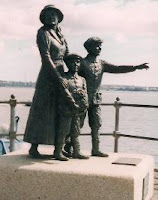
The wind blew her red hair and tears blurred her vision as she thought about leaving her Irish homeland. But she was also excited about seeing her parents who had gone to America two years earlier with her older brother.
Annie and her brothers were in steerage class for 12 days. They lived in a large room with many other people on the crowded ship. The Statue of Liberty was welcome site on January 1, 1892. The crowd cheered and as they approached Ellis Island everyone was happy the voyage was over.
Annie was the first off the ship and was surprised when an official handed her a $10 gold piece. He explained to the puzzled girl that Ellis Island was new, and the $10 was a gift to the first person to enter the United States through Ellis Island. It was  Annie‘s 15th birthday!
The story was that after a few years she left New York and died in her 30s somewhere in the south.
However, several days later while walking in Dublin we struck up a conversation with a fellow who told us that newspapers had recently been full of the story that the woman who died was another Annie Moore and that the first immigrant never left New York and presumably lived a normal life span.
A replica of the statue of Annie and her brothers also stands on Ellis Island.

Saturday, January 29, 2011

THE U S PALACE

IOLANI PALACE

This is one exception to my posting of US sites. I have always loved the Iolani which was just about to undergo restoration when we moved back to the mainland. I was delighted to see the wonderful results a few years later on a stopover visit enroute to Midway.
One might think that Iolani Palace is located in some exotic location, but being  the only palace in the United Stated, it sits in downtown Honolulu, Hawaii. It was the official residence of King Kalakaua from 1882 until his death in 1891. Kalakaua played an active role in the construction of the palace making sure innovations of the time like toilets, sinks, running water, electric lights and telephones were installed. His sister, Queen Liliuokalani lived in the palace until the overthrow of the Hawaiian monarchy in 1893. The coronation of the king and his consort, Queen Kapiolani took place in 1883.
The present structure stands close to the old palace which termites destroyed. King Kalakaua took up residence as soon as the palace, which cost $360,000 to build, was completed. The basement housed kitchens, storerooms, and household staff offices. The main floor was used for formal functions, while the second floor was devoted to family living quarters. The large attic merely provided air space to keep the floors below cool.
A wide curved staircase, carved of Hawaiian woods, dominates the wide hall that runs the length of the palace. Portraits of Hawaiian royalty line the walls above niches displaying valuable vases and statuary.
Crimson and gold dominate the Throne Room, the scene of royal audiences, balls and receptions. Small receptions and informal audiences took place across the hall in the Blue Room. The huge painting of a French King  was presented to King Kamehameha III in 1848. Beautiful carved sliding doors separate the Blue Room from the State Dining Room. The massive sideboards in this room were specially made in Boston, Massachusetts. The King and Queen suites are on opposite sides of the hall.
From 1893 to 1968 the palace served as the capitol of the Republic, the Territory and finally of the state. During that time the Throne Room was used by the House of Representatives and the State Dining Room was the Senate Chamber. In 1969 when the new capitol was completed the palace was vacated so restoration could begin.
When you visit, be sure to take a guided tour to learn many more details of America’s only Royal Palace.

In Hawaii don’t expect to hear north, south east and west when given directions. Instead you’ll hear makai (toward the water), Waikiki, Ewa and mauka (toward mountains)
June 11 is Kamehameha Day and since it is also my birthday I always celebrated with a festive parade!


Wednesday, January 26, 2011

HISTORIC RESTAURANT

        AN OLDIE

In Passau, Austria our city guide told us, “The restaurant across the street from your hotel was established by monks in 1358, and has been in continuous operation in the same location ever since.”
How about that for longevity!
We were told that the rule in Passau was that a glass of wine cannot cost more than twelve times the cost of a breakfast roll. The wine was a white one and was called Stift. It came from Krems.
            Of course over the years the price of the breakfast roll has increased and the serving size of the wine has decreased. Never the less, several of us had to have lunch in that restaurant. We paid dearly for a very mediocre lunch and the ambiance, but the wine was wonderful. In fact we continued to buy Stift wine all across Austria.
            Sometimes there are just things one must do when traveling to new and different places and having lunch in a 600 + year old restaurant fell into that category.


Sunday, January 23, 2011

A FRIENDSHIP BRIDGE

A BEAUTIFUL BRIDGE

The Old Bridge at Mostar, Bosnia was conceived during the Ottoman Empire in 1566. The graceful 65-foot long, stone, arched bridge spanning the Neretva River replaced a narrow wooden foot bridge. The original stone bridge survived until the war of 1991 when it was totally destroyed. A temporary wooden bridge spanned the river from 1993 to 2004. The present bridge, an exact replica of the original, used stone from the same quarry,
Our guide said, “It is estimated that the original stone bridge would have cost 50,000 Euro to build, the replacement bridge cost 50 million Euro in 2004. The stone  is spongy and if it gets too wet it crumbles, but it can be molded when damp. The stone that fell into the river was not reusable as it had been too wet for too long. It took five years of preparation to replace the bridge but only a year to actually build it.”
 Croats live on the west side of the bridge and Muslims on the east side. The city is internationally known for its Old Town Bridge that now is a symbol of reconciliation, cooperation, and coexistence of diverse cultural, religious, and ethnic communities. There are many mixed marriages, and during the war many children had to choose between Mom or Dad.
Our guide explained, “The semi-circular Tara building on the west side of the bridge was used to store ammo and gun powder during Ottoman rule. Now it houses the divers’ co-op. The Helebija on the east bank once held dungeons on the bottom and guards on the top.
“Divers used to dive off the bridge for cigarettes. Then they dove for money. They would work in pairs, one poised to dive while the other clapped his hands to gather a crowd and collect donations. The diver would not dive until enough money had been collected.”
 Today diving is done during competitions in July, otherwise diving from the bridge is forbidden. The waters 65 feet below flow swiftly making   diving  dangerous. Today a kayak floats  under the bridge and an ambulance is on the shore to cope with mishaps and emergencies during the competition.
The bridge, now a UNESCO site is picturesque with an interesting history.